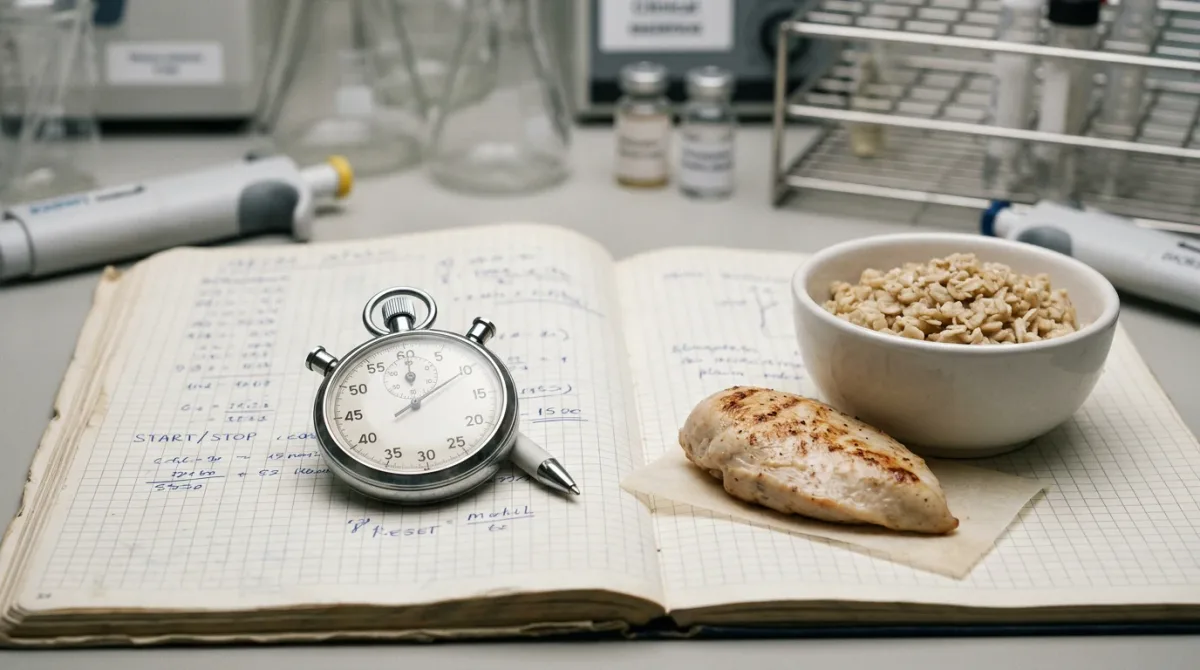
Consuming protein within a narrow window right after a workout does not appear to be essential for building muscle, according to a 2013 meta-analysis in the Journal of the International Society of Sports Nutrition. The timing effect largely disappeared once researchers accounted for how much protein people ate across the whole day; total intake, not the clock, was the stronger predictor.
What is the "anabolic window" theory?
The anabolic window, sometimes called the metabolic window or protein window, is described as the short stretch after training when muscle tissue is actively repairing itself. The popular version of the claim, as reported by Healthline, pegs that stretch at around 30 minutes: eat protein and carbohydrate inside it, the theory goes, and the meal does more for muscle growth than the same food eaten later.
The idea rests on a real physiological fact: resistance exercise temporarily tips the balance between building and breaking down muscle protein toward breakdown. The window theory extends that fact into a specific, ticking deadline for reversing it. That extension is the part the evidence has tested most directly, and tested hardest.
The claim became a fixture of gym culture and a recurring hook in sports-nutrition marketing, often illustrated with a stopwatch or a shaker bottle. Its popularity outran the underlying research long before most of that research existed.
What does the largest review of the evidence find?
The most-cited answer comes from a meta-analysis by Schoenfeld, Aragon, and Krieger, published in the Journal of the International Society of Sports Nutrition in December 2013. It pooled randomized trials comparing protein consumed close to a resistance-training session against protein consumed later: 23 studies and 525 nested effect sizes for muscle size, 20 studies and 478 for strength.
In a basic, unadjusted comparison, timed protein showed a small-to-moderate advantage for muscle size and no measurable advantage for strength. Once the authors ran a fuller statistical model that adjusted for other variables at play in the same trials, the size advantage stopped being statistically significant too.
The single strongest predictor of muscle growth in the pooled data was not when protein was eaten but how much of it people ate across the full day. The authors' own conclusion was that adequate total protein, paired with resistance training, was the key factor — timing was not.
The analysis carried real limits. Most participants were untrained beginners; only four of the pooled trials involved already-trained lifters. Control groups in the underlying trials ate their protein at widely different intervals from each other, and few trials matched total daily protein between the timed and non-timed groups — both of which blur a clean comparison.
| Statistical model | Effect on muscle size | Effect on strength |
|---|---|---|
| Basic, unadjusted comparison | Small-to-moderate advantage for timed protein | No measurable advantage |
| Full model, adjusted for other variables | No significant advantage | No significant advantage |
Does eating protein before versus after training make a difference?
Separate trials cited in Healthline's reporting on the topic point the same direction. One study found that protein eaten before a workout and protein eaten after produced similar muscle adaptations over time; another found that immediate post-workout protein and protein delayed by about an hour produced similar changes in the rate muscle tissue builds new protein. Healthline also reports that the rise in muscle protein breakdown after a workout is a gradual, extended process rather than a brief spike that closes within minutes — which undercuts the idea of a short, ticking cutoff.
None of this is presented as proof that timing is completely irrelevant. It is evidence that the "opportunity" is considerably wider than a 30-minute clock, and that a meal eaten an hour or so before or after training is not obviously wasted.
Does the picture change for beginners, experienced lifters, or fasted training?
The trained-versus-untrained question is one the evidence cannot yet answer with confidence. Because only a handful of the pooled trials in the 2013 meta-analysis involved already-trained subjects, the finding that timing does not matter much rests mostly on data from people newer to resistance exercise. Whether the same holds for people with years of training is not established either way.
Fasted training looks like a genuine exception, based on a study cited in Healthline's reporting: training on an empty stomach was linked to a larger rise in muscle breakdown during the session itself, compared with training after eating. That points to a difference between skipping food around a workout and simply choosing which hour to eat it in — the two are not the same question, even though both get filed under "timing."
What does the sports-nutrition field's own guidance say?
The International Society of Sports Nutrition, the professional body most closely associated with this research area, published a position stand on nutrient timing in the Journal of the International Society of Sports Nutrition on August 29, 2017, led by Kerksick and coauthors. It states that, across the research it reviewed, high-quality protein eaten anywhere from immediately after exercise up to roughly two hours afterward is associated with strong increases in the rate the body builds new muscle protein.
The same position stand adds an important qualifier: the size and timing of the meal eaten before exercise changes how much post-exercise eating is actually needed to sustain that effect. In other words, the field's own summary treats the post-workout window as one variable inside a person's broader eating pattern that day, not as an isolated rule that overrides everything eaten before it.
What predicts muscle growth, if not the clock?
Across the sources reviewed here, the factor that keeps outperforming timing in the data is total protein intake over the day. In the 2013 meta-analysis, adjusting for total protein intake was what made the apparent timing advantage disappear — a pattern the authors read as total intake doing the real work, with timing riding along as a secondary marker rather than a separate cause.
That does not mean every hour is interchangeable, and it does not mean a specific gram target; the research summarized here describes patterns across groups of people in trials, not a personal target for any individual. It means the evidence does not support treating a narrow post-workout minute as make-or-break for muscle growth, while leaving open real gaps — particularly for trained athletes and for exactly how wide the useful window really is.
Frequently asked questions
Is there a strict window that closes a set number of minutes after a workout?
The often-cited 30-minute figure is a popularized version of the theory rather than a cutoff measured in trials. The 2013 meta-analysis found the timing advantage stopped being statistically significant once total daily protein was accounted for, and other cited trials found similar outcomes whether protein came before, immediately after, or about an hour after training.
Does timing matter more for beginners than for experienced lifters, or the reverse?
This is not established either way. Most of the trials behind the "timing doesn't matter much" finding involved untrained participants; only a handful of the pooled studies involved already-trained lifters, so the evidence for that group specifically is thin.
If someone eats a meal before training, does the post-workout window still apply?
The 2017 ISSN position stand notes that the size and timing of a pre-exercise meal changes how much post-exercise protein is needed to sustain the same effect, treating pre- and post-workout eating as connected rather than separate rules.
Does training on an empty stomach change any of this?
Fasted training appears to be a genuine exception: a study cited in Healthline's reporting found it was linked to a larger rise in muscle breakdown during the session compared with training after eating, which is a different question from which hour a meal is eaten in.
This article is for information only. It is not medical or nutrition advice, and it does not recommend any dose, dietary supplement, or eating protocol. Anyone making decisions about diet around exercise should talk with a qualified clinician or registered dietitian.
For a related fitness perspective, read Does the post-workout anabolic window actually exist?.
For more context, read Does the post-workout anabolic window actually exist?.