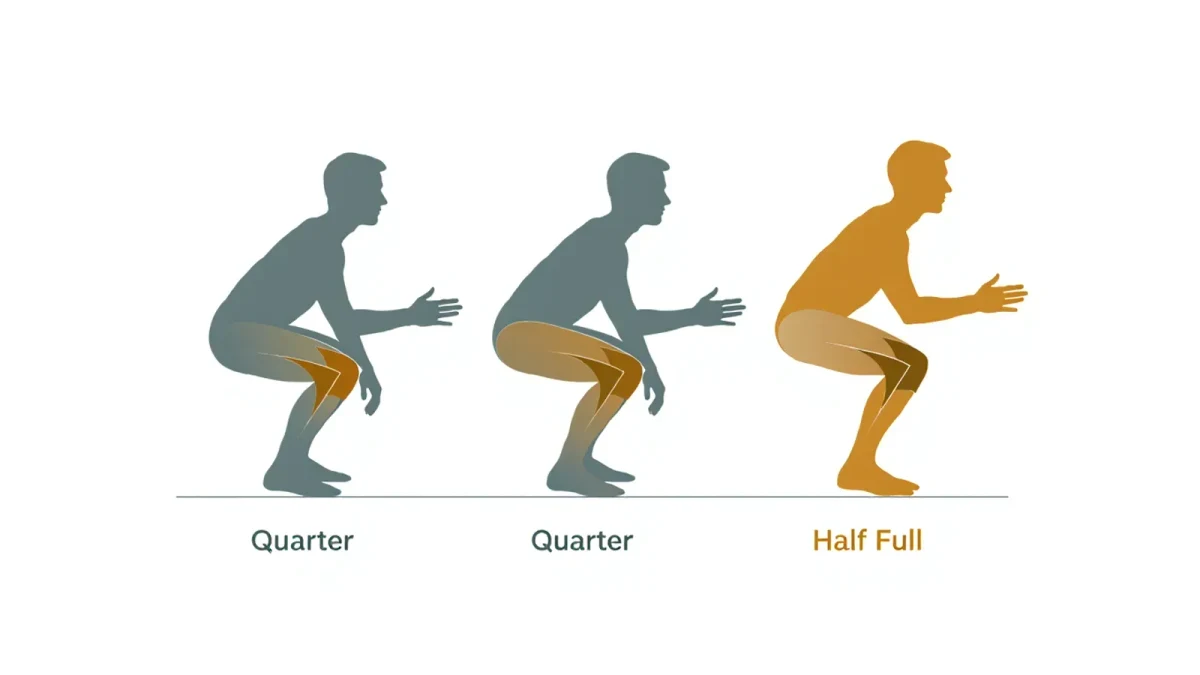
Deeper squats build more thigh muscle, especially on the adductors, glutes, and hamstrings. A 12-week controlled trial by Bloomquist and colleagues in 2013 found full-range squats produced greater hypertrophy of the thigh and hip musculature than half squats, and a 2019 study by Kubo and colleagues found full squats grew the gluteus maximus and hamstrings more while all depths grew the quadriceps similarly. On the safety side, reviews — including Hartmann and colleagues' 2013 examination of deep-squat biomechanics — conclude that healthy knees tolerate deep squats, with the highest kneecap-tendon stresses occurring around 90 degrees.
24 News Click publishes information, not medical or training advice. Individual programming decisions belong with a qualified exercise professional and, where health conditions exist, a clinician.
Does squat depth change which muscles grow?
Yes, and the pattern is consistent across trials. Deep squats recruit the gluteus maximus, hamstrings, and adductors substantially more than partial squats, because hip flexion deepens and those muscles lengthen under load. Bloomquist's 2013 trial in young trained men — 12 weeks of full squats versus half squats — found significantly greater growth of the thigh and hip extensor musculature in the full-squat group. Kubo's 2019 comparison of full, half, and quarter depths similarly found the glutes and hamstrings responding most to full depth.
The quadriceps are the exception: in Kubo's data, all depths produced similar quadriceps growth when training was equated for load and effort. A lifter chasing quad size can grow on moderate depth; a lifter wanting posterior-chain and adductor development needs the deep position.
Is deep squatting bad for the knees?
Not for healthy knees, according to the biomechanics literature. Hartmann and colleagues' 2013 review in Sports Medicine analyzed deep-squat kinetics and concluded that peak patellofemoral and patellar-tendon stress occurs around 90 degrees of knee flexion — roughly the parallel point — and declines toward full flexion as the wrap-around geometry of the joint changes contact area. Deep squats, in this account, move the joint past its most stressed angle rather than into it.
Two honest qualifications follow. The evidence covers healthy joints; people with existing knee pathology, cartilage injury, or pain were not the studied population, and for them depth is a clinician's question. And load grows with tissue tolerance — the injury data on resistance training shows progressions failing at loads beyond current conditioning, not at depth itself.
What about strength through partial ranges?
Partial squats allow much heavier loads, and strength is angle-specific: studies of range-of-motion training, including work by Graf and colleagues, show partial-range training improves strength most strongly in the trained range. Powerlifters, whose sport judges hip-below-knee depth, train the competition depth; their partial work is supplemental overload, not a replacement.
For general strength, joint-angle specificity argues for training the full range: gains measured at one angle transfer incompletely to others, a finding consistent across range-of-motion studies. The heavier loads of partial squats buy top-range strength, at the cost of the bottom-range strength and hip musculature that full squats develop.
Can everyone reach full depth safely?
Depth is anatomy-dependent, not universal. Hip-structure studies — including the influential 2014 work by Lam and colleagues on hip morphology and the widely cited anatomical observations of bone-hip variation — show that acetabular depth and femoral-neck angle differ between individuals, changing the deepest squat each hip can reach without bony limitation. Ankle mobility further shifts what an upright torso requires at depth.
The research answer is not forcing one position but finding the deepest range the individual controls under load — a view reflected in coaching standards that judge depth by hip-crease-to-knee relationships while acknowledging individual variation. No trial assigns a universal required depth for safety or hypertrophy.
How were these studies designed?
Small, in young trained or recreationally trained men, mostly 8 to 12 weeks. Bloomquist's trial randomized 17 subjects to full or half squats; Kubo's compared three depth groups over 10 weeks with per-depth loads. Electromyography studies of depth — including work by Caterisano and colleagues showing higher glute and hamstring activation in full squats — add activation data, which supports but does not by itself prove growth differences.
The pooled evidence direction is clear — depth helps posterior-chain and adductor hypertrophy and is safe for healthy knees — but effect sizes rest on a handful of small trials, and none establish that partial squats are useless: they load the quads and permit heavier top-end work.
How should depth fit into a training plan?
Depth is a programming variable, not a moral position. A defensible pattern from the trial designs: build the base pattern at the deepest well-controlled range, load it progressively, and treat heavier partial-range work as an occasional supplement for top-end strength rather than the default squat. This mirrors how the successful arms of the depth studies were written — full-range groups progressed loads at their depth, partial groups at theirs, and each got better at what it practiced.
Technique stability comes before depth chasing. Load studies in resistance training consistently show repetition quality degrading before it collapses; a squat that loses lumbar position or heel contact at depth is a mobility or load question, and the research response is adjusting depth or load, not grinding. Shoes with a heel raise or a temporary heel wedge are common, low-cost ways to reach depth with an upright trunk when ankle range is the limiter — a practice reflected in coaching literature rather than tested in controlled trials.
Progression of depth itself, where needed, is gradual: a slightly deeper range every few weeks, held to the same control standard, matches the incremental logic of the progression literature.
Squat depth and outcomes across the trials
| Outcome | Full / deep squat | Partial / half squat |
|---|---|---|
| Quadriceps growth | Similar across depths (Kubo 2019) | Similar (Kubo 2019) |
| Glutes, hamstrings, adductors | Greater growth and activation (Bloomquist 2013; Kubo 2019; Caterisano) | Less |
| Maximal load | Lower absolute load | Much heavier loads possible |
| Knee stress (healthy joints) | Peak stress near ~90°, not at bottom (Hartmann 2013) | Spends time near peak-stress angle |
FAQ
Are deep squats better for muscle growth?
For the thighs and hips overall, yes — Bloomquist's 12-week trial found greater growth with full squats than half squats, strongest in the adductors and hip extensors. The quadriceps themselves grew similarly across depths in Kubo's 2019 study.
Is squatting below parallel bad for knees?
The biomechanics review evidence indicates peak kneecap stress around 90 degrees of flexion, not at the bottom of a deep squat, and healthy knees tolerate full depth. Existing knee pathology changes the calculus and belongs with a clinician.
Why do powerlifters squat below parallel?
Their sport's rules require hip crease below the knee. Their training reflects rule depth plus joint-angle specificity: strength is built at the angles trained, and competition depth is the angle judged.
What if full depth causes hip pinching?
Hip anatomy varies between individuals — femoral-neck angle and socket depth differ — so the deepest comfortable depth varies too. The research supports the deepest range a person controls without pain, not a forced universal position; persistent pinching is a clinician question.