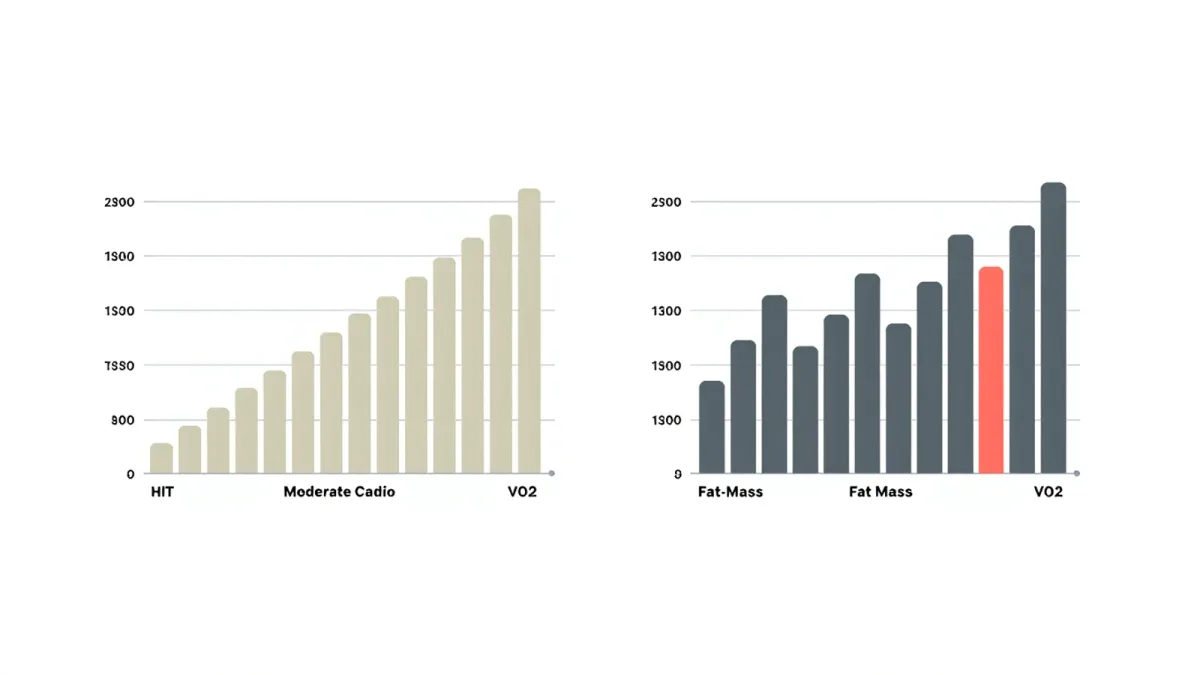
High-intensity interval training produces larger gains in maximal oxygen uptake per unit of training time than moderate continuous training: a 2015 meta-analysis by Milanović and colleagues, pooling 55 studies, found HIIT and sprint-interval protocols superior to moderate-intensity continuous training for VO2max. Steady-state work still improves aerobic fitness reliably — it simply needs more minutes, and it costs less recoverability and joint stress. Neither method is universally better; the trade is time-efficiency against strain and preference.
24 News Click publishes information, not medical or training advice. Individual programming decisions belong with a qualified exercise professional and, where health conditions exist, a clinician.
What did the head-to-head comparisons find?
For VO2max, intervals win on rate. The Milanović 2015 meta-analysis in Sports Medicine compared interval and continuous protocols across 55 studies and found greater maximal oxygen uptake improvements with HIIT and sprint intervals than with moderate continuous work. Time-efficiency research from Gibala's laboratory — including the widely cited Wingate-based and reduced-exertion protocols — showed interval sessions of roughly 10 minutes including warm-up producing aerobic adaptations comparable to far longer continuous sessions over the same multi-week period.
For health markers, differences narrow. Meta-analyses of cardiometabolic outcomes — insulin sensitivity, blood pressure, resting heart rate — generally find both modalities effective, with some analyses favoring intervals modestly and others finding parity when total work is matched. The honest summary: intervals are the faster tool for the aerobic engine; the health dividend mostly follows total activity.
Why is HIIT more time-efficient?
Because intensity, not duration, is the primary stimulus for central adaptations. VO2max gains depend substantially on exposing the heart to near-maximal output, which only near-maximal work provides. A 4x4-minute interval structure at roughly 85 to 95 percent of maximal heart rate — the Norwegian protocol tested across multiple trials — drives stroke volume to its ceiling repeatedly; a 40-minute easy session never approaches it.
Time-efficiency has a strict ceiling of its own. True HIIT sessions cannot be extended much beyond roughly 20 to 30 minutes of hard work: intensity collapses, and the session quietly becomes steady state with a warm-up attached. Weekly hard-interval volume is also self-limiting, with coaching practice and trial protocols alike capping interval sessions at roughly two to three per week between recovery days.
What does steady state do better?
Volume and repeatability. Moderate continuous cardio can be done daily, at any age, with minimal equipment and low injury risk — the qualities that make it the backbone of public-health activity guidelines, which recommend 150 to 300 weekly minutes of moderate activity. It builds the mitochondrial and capillary base — the zone 2 adaptations — without the recovery tax intervals impose, and it can be held for hours in events where duration is the point.
Steady state also suits people for whom high intensity is a poor fit: joint conditions, very low fitness starting points, cardiac risk factors requiring clinician clearance, or simply dislike. Adherence research repeatedly shows enjoyment predicts continuation, and sprinting through dislike is a known dropout pattern in the trial base.
Is HIIT riskier?
Moderately, in specific ways. Non-fatal musculoskeletal injuries and, in cardiac-rehabilitation debates, cardiovascular events during maximal exertion are the two discussed categories; reviews of interval training in clinical populations, including cardiac patients under supervision, report good overall safety, while unsupervised maximal efforts in sedentary adults carry higher transient risk. The evidence does not support fear — supervised HIIT is used safely with heart patients — but it does support gradual entry.
Overuse is the likelier recreational problem. Repeated maximal sessions without recovery produce the fatigue and performance staleness the monitoring literature describes, and the fix — fewer hard days — costs nothing.
Can both be combined?
Yes, and most training guidance converges there. A pattern of mostly moderate work plus one or two interval sessions captures both adaptation routes and mirrors the polarized distributions observed in Seiler's 2010 data on endurance athletes — roughly 75 percent of sessions easy, a small share hard. For general fitness, two easy 30-minute sessions plus one interval session weekly exceeds guideline minimums and covers both stimulus types.
Sequence within the week matters modestly: hard days separated by at least one easy day, per the recovery spacing used in essentially all interval trials.
Which burns more calories?
Per minute during the session, higher intensity burns modestly more; per hour of real life including recovery and showering, the difference is smaller than commonly claimed. Matched-work comparisons put fat loss on the energy deficit, not the modality, and meta-analyses of interval versus continuous training for body composition find small or no differences when energy expenditure is equated.
The afterburn effect — excess post-exercise oxygen consumption — is real but proportionally small, a finding stable across many studies. It does not turn a 15-minute interval session into an hour of continuous work.
Interval formats also vary more than the label suggests. The 4x4-minute Norwegian structure, 30-second sprint protocols, and 60-second work-rest ratios all count as HIIT in the meta-analyses while imposing very different strains; the pooled superiority is an average across formats, not a guarantee from any single recipe.
How should a beginner choose between them?
By starting point and constraint, not by which method trends. A sedentary beginner improves on almost any consistent stimulus — the early-plateau literature shows the steepest gains arrive in the first weeks regardless of format — so the modality that gets done three times weekly beats the optimal one done occasionally. Continuous moderate work is the lower-strain entry; intervals can be layered in after a base exists, exactly the sequence used in most supervised trials.
Health screening matters more with intervals. Standard pre-exercise guidance — and the clearance logic in cardiac-rehabilitation research — directs people with cardiovascular risk factors, symptoms, or long inactivity to clinician involvement before maximal efforts. Moderate walking-pace work carries no comparable threshold.
Beyond entry, the choice becomes arithmetic: scarce time pushes toward intervals; abundant time, event goals, or joint sensitivities push toward steady volume. Most people settle on the mix described above rather than a single camp.
HIIT versus steady state at a glance
| Dimension | HIIT | Steady state |
|---|---|---|
| VO2max per minute trained | Superior (Milanović 2015) | Reliable but slower |
| Recoverability | 2–3 hard sessions weekly cap | Near-daily possible |
| Joint and entry risk | Higher; gradual entry advised | Low |
| Calories and fat loss | Similar when energy matched | Similar when energy matched |
| Guideline fit | Counts toward activity | Backbone of 150–300 min guidance |
FAQ
Is HIIT better than steady-state cardio?
For raising VO2max per training minute, yes — the 2015 Milanović meta-analysis of 55 studies found interval training superior. For daily volume, joint-friendliness, and adherence, steady state holds the advantages. Neither is universally better.
How many HIIT sessions per week is safe?
Trial protocols typically used two to three interval sessions weekly with recovery days between. Supervised interval training has been used safely even in cardiac populations, but gradual entry is the consistent recommendation for sedentary beginners.
Does HIIT burn more fat than steady state?
During the session, higher intensity uses modestly more energy per minute. When total energy expenditure is matched, fat-loss outcomes are similar across modalities — the deficit, not the format, decides.
Can steady state replace intervals entirely?
For health and base fitness, yes — guideline-level moderate activity delivers well-documented benefits. For time-pressed people seeking maximal aerobic gains, intervals are the faster documented route.