For building muscle, volume has the stronger evidence trail: a 2017 meta-analysis by Schoenfeld and colleagues found that hypertrophy increases with the number of hard weekly sets per muscle, while a 12-week trial by Morton and colleagues in 2016 found similar growth at roughly 30 percent and 80 percent of one-repetition maximum when volume was matched. In plain terms, how many quality sets a lifter accumulates matters more than how heavy each set feels, provided each set is taken reasonably close to failure.
24 News Click publishes information, not medical or training advice. Individual programming decisions belong with a qualified exercise professional and, where health conditions exist, a clinician.
What do researchers mean by volume and intensity?
Volume in the hypertrophy literature is usually counted in weekly sets per muscle group, and intensity as the load relative to one-repetition maximum — the heaviest load liftable once. A third term, proximity to failure, describes how close a set ends to the point where no further clean repetition is possible.
The definitions matter because they change the answer. Volume measured as total kilograms lifted (sets times reps times load) rises automatically when heavier weights are used, which confuses older studies. Newer research counts sets — and specifically sets taken within a few repetitions of failure — as the cleaner dose unit. Intensity in the research sense is a percentage, not a feeling of effort.
A set at 70 percent of one-repetition maximum, stopped two reps short of failure, and a set at 85 percent stopped two reps short, represent similar effective effort but very different tonnage. Most current reviews treat them as roughly equivalent growth stimuli when rep count and proximity to failure are equal.
What did the volume meta-analyses find?
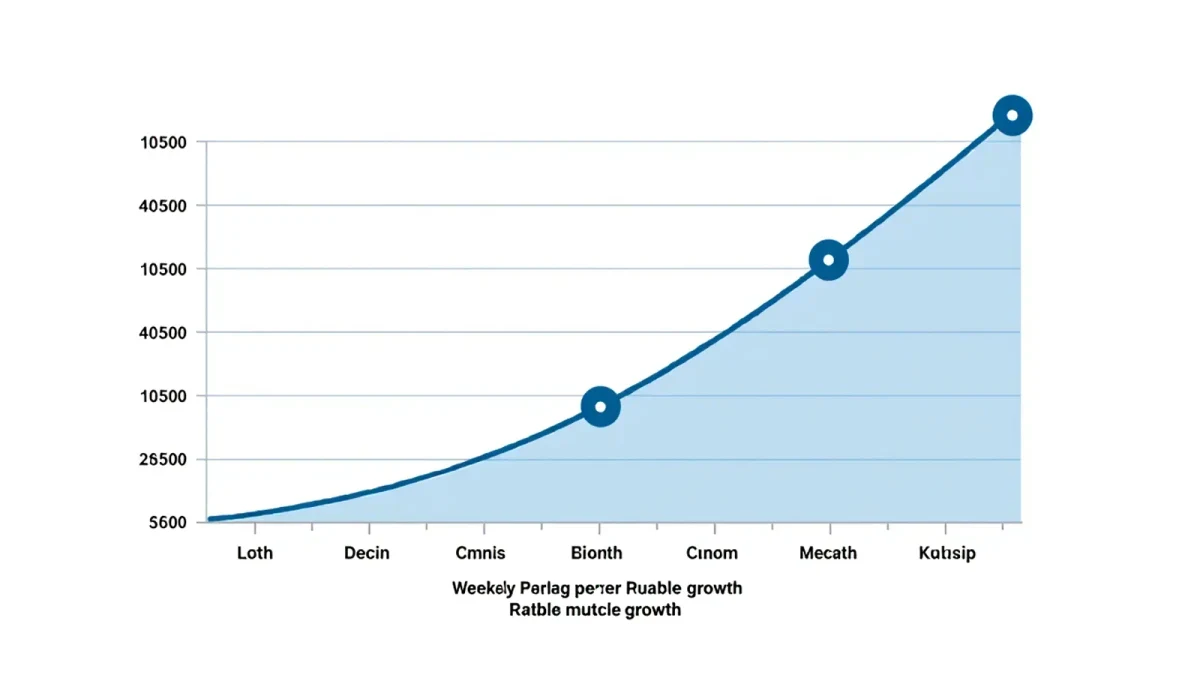
More weekly hard sets produced more growth, up to the ranges studied. Schoenfeld, Ogborn, and Krieger's 2017 dose-response meta-analysis in the Journal of Sports Sciences grouped studies by weekly sets per muscle and found that ten or more sets produced roughly double the hypertrophy of one set or fewer, with the middle groups in between. A 2017 analysis by Ralston and colleagues comparing one-set and multi-set programs reported meaningfully greater growth — on the order of 20 to 40 percent in effect-size terms — for higher set counts.
A 2022 meta-analysis by Baz-Valle and colleagues sharpened the picture: across controlled trials, more weekly sets kept producing more growth, with no clear plateau inside the ranges tested, but with diminishing returns per added set. Ten sets bought more than five; the second ten bought less than the first.
The honest limit of these analyses is that few trials push beyond about 20-plus weekly sets per muscle, so the ceiling of the curve is extrapolated, not measured. The research also says nothing about what any individual should do — it describes averages across mostly young trained men.
What did the load studies find?
When sets are taken close to failure, load percentages from roughly 30 to 85 percent of one-repetition maximum produce broadly similar hypertrophy. The strongest single trial remains Morton and colleagues' 2016 study at McMaster University: 49 resistance-trained men, 12 weeks, whole-body training at about 30 percent or about 80 percent of one-repetition maximum, volume-equated. Muscle growth in the quadriceps was similar between groups; strength gains were greater at the heavier load.
Meta-analyses of load effects, including work by Schoenfeld and colleagues published in 2017 and follow-up reviews, support the same pattern: hypertrophy differs little across moderate and heavy loads when volume is equated and effort is high, while maximal strength favors heavier loading. Very light loads — below about 30 percent — are less well supported, and training far from failure blunts the response regardless of load.
Practically, the load question settles into a range: weights heavy enough that a set ends within roughly 5 to 30 repetitions of clean work, and close enough to failure that the last reps are genuinely hard.
One caveat deserves equal billing. The load-independence findings rest on sets performed with high effort. A light set stopped with many repetitions still in the tank is not a growth stimulus in any of these trials, and reviewers repeatedly flag this as the most common misreading of the Morton study.
Why does the distinction matter for regular lifters?
Because the two levers fail differently. A lifter chasing intensity alone — always heavier, few sets — accumulates less weekly volume than their effort suggests, and hypertrophy follows volume. A lifter chasing volume alone — many light sets stopped well short of effort — misses the proximity-to-failure requirement and also under grows. The evidence points at the intersection: enough hard weekly sets, at loads that permit clean execution, each set finishing near failure.
The mismatch also explains common plateaus. Reviews of real-world training patterns note that recreational lifters systematically overestimate how close their sets finish to failure, and underestimate how few hard sets they actually perform per muscle per week.
Do strength goals change the answer?
Yes. Maximal strength is a specific skill measured at heavy loads, and it responds specifically to heavy loads. In the Morton trial and in the load meta-analyses, one-repetition-maximum gains favored the heavier-loading groups even where muscle growth was equal. For lifters whose goal is the number on a maximal lift, intensity — practice at high percentages — becomes a primary variable, not a secondary one.
For size, the ordering holds: volume first, effort second, load third. For strength, load moves up the list. Most of the research covers young trained adults; data in older adults and women remains thinner, though available trials show the same volume direction.
Volume versus intensity at a glance
| Variable | Effect on muscle growth | Effect on maximal strength |
|---|---|---|
| Weekly hard sets (volume) | Strongest dose-response driver (Schoenfeld 2017; Baz-Valle 2022) | Positive, largely through more practice |
| Load percentage (intensity) | Similar across ~30–85% 1RM when effort matched (Morton 2016) | Heavier loading favored (Morton 2016; load meta-analyses) |
| Proximity to failure | Required; sets far from failure blunt growth | Less critical; heavy singles are far from failure by design |
FAQ
How many sets per week does the research suggest?
The 2017 Schoenfeld dose-response meta-analysis found roughly double the hypertrophy with ten or more weekly sets per muscle versus one set or fewer, and the 2022 Baz-Valle analysis found continued, diminishing gains with more sets. These are group averages from controlled trials, not individual prescriptions.
Can light weights build muscle as well as heavy ones?
When sets are taken close to failure and volume is equated, yes — the 2016 Morton trial found similar quadriceps growth at about 30 percent and 80 percent of one-repetition maximum in 49 trained men over 12 weeks. Strength gains favored the heavier load.
Which should a beginner add first, sets or weight?
The research literature does not test this choice directly. The volume evidence suggests hard sets are the growth currency, so beginners typically add load while a rep range is achievable, then add sets once load progression slows — a sequencing pattern described in the ACSM progression position stand.
Does intensity matter at all for hypertrophy?
It sets the range of usable repetitions and the strength-specific adaptation. Load meta-analyses show hypertrophy is broadly load-independent between roughly 30 and 85 percent of one-repetition maximum, but each set still needs to approach failure for growth to occur.