Eating carbohydrate before morning training improves endurance performance in trial after trial, while fasted training increases fat burning during the session without improving performance or body composition in controlled studies. A 2018 meta-analysis by Aird and colleagues found no performance benefit from fasting before exercise, and a 2014 randomised trial by Schoenfeld and colleagues found no body-composition advantage over weeks of matched training. The choice is therefore about goals and tolerance, not a metabolic shortcut.
24 News Click publishes information, not medical advice. Runners with diabetes or other metabolic conditions should discuss fasted training with a clinician.
What does eating before exercise do?
A pre-training meal tops up liver glycogen, which falls overnight and is the main backup for blood glucose during exercise. The joint position stand of the Academy of Nutrition and Dietetics, Dietitians of Canada, and the American College of Sports Medicine supports roughly 1 to 4 grams of carbohydrate per kilogram of body weight in the one to four hours before exercise. Overnight, liver glycogen drops substantially, which is why morning sessions start with a smaller tank than evening ones.
The performance effect is documented mainly for endurance exercise beyond about an hour. For short easy sessions, the evidence for pre-exercise carbohydrate is weak; the body's own stores are ample for a 30-minute jog.
Does fasted training burn more fat?
Yes, during the session. Fasted morning exercise raises the proportion of energy from fat and lowers carbohydrate oxidation, a finding reproduced across many studies in the Aird meta-analysis and elsewhere. But fat burned during a session is not the same as body fat lost over weeks.
When total calories and training are matched, fasted training shows no body-composition advantage. The Schoenfeld trial in young women, and a later study in men by the same group, found similar fat loss between fasted and fed groups over weeks. The energy balance over the day, not the fuel mix during one session, drives fat loss.
Does fasted training improve performance?
The evidence says no, and for harder sessions it points the other way. The 2018 Aird meta-analysis concluded fasting did not enhance performance and was associated with higher perceived effort in some trials. Sessions intended to be fast — intervals, threshold work — depend on carbohydrate, and reviews of train-low research note that quality suffers when they are done unfueled.
That is why sports dietitians distinguish between types of sessions: an easy conversational run can be done fasted with little measurable cost, while intervals before breakfast usually produce slower repeats. Chronic low-carbohydrate availability also carries the RED-S risks documented by the International Olympic Committee.
What should an early-morning meal look like?
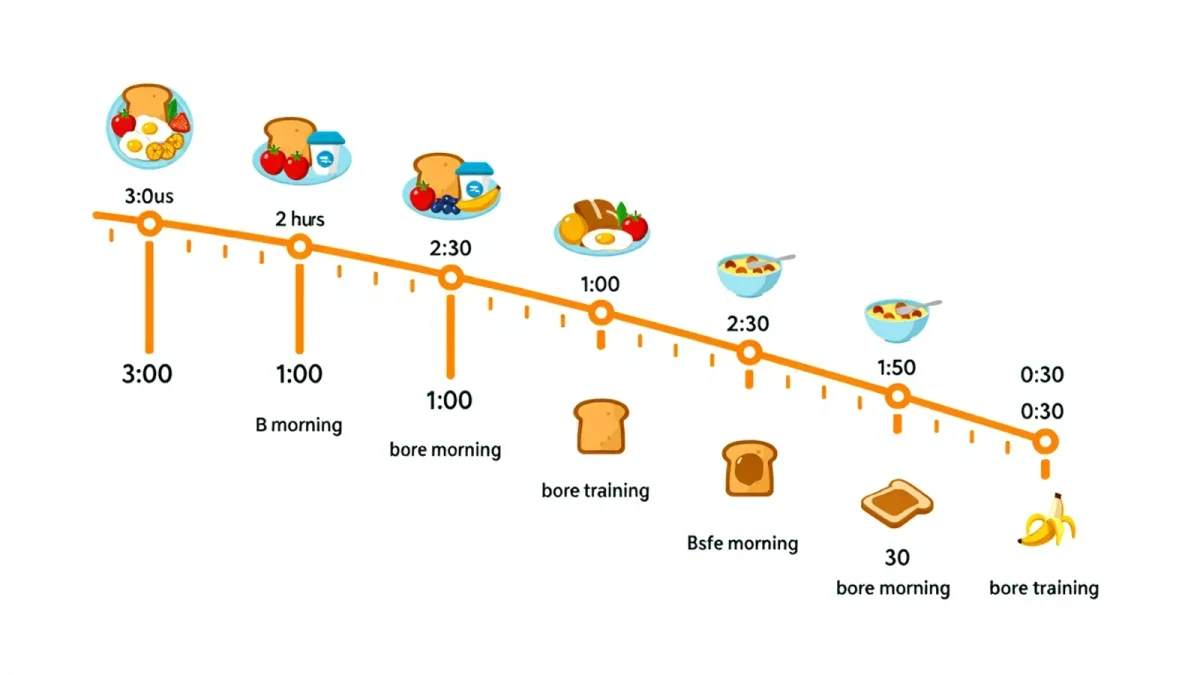
The timing arithmetic comes from gastric emptying and digestion research: larger meals need two to three hours, smaller carbohydrate snacks can be eaten 30 to 60 minutes out. A 6 a.m. runner with a 6:30 start has room for a small, familiar, low-fiber carbohydrate snack — banana, toast with honey, or a sports drink — rather than a full breakfast.
The position-stand range of 1 to 4 grams per kilogram spans this spectrum: the top end suits a race-day morning with three hours available, the bottom end suits a short pre-workout top-up. Practicing the choice in training is the standard recommendation, since gut tolerance is highly individual and novelty on hard mornings is a documented source of problems.
Is coffee before training a substitute for food?
No, but it is a separate, well-supported tool. Caffeine's endurance benefits are among the most replicated findings in sports nutrition, with a 2019 meta-analysis by Grgic and colleagues supporting performance improvement at doses around 3 to 6 milligrams per kilogram. Caffeine does not, however, provide fuel, and its appetite-suppressing and gut-stimulating effects vary by person.
Black coffee before fasted cardio is common practice and compatible with either choice on fuel. The evidence-based separation: caffeine for stimulus, carbohydrate for fuel.
Does fasted training have any legitimate use?
Some, within limits. Train-low research — including the sleep-low studies in trained athletes — uses deliberately low carbohydrate availability to stress fat metabolism and some adaptation signals, and the National Institutes of Health Office of Dietary Supplements describes carbohydrate periodization concepts in its materials on exercise nutrition. But the same research shows mixed performance outcomes and impaired session quality, and the IOC warns about chronic underfueling.
The moderate reading of the literature: occasional fasted easy sessions are a tool, not a program. Daily fasted hard training stacks costs without demonstrated payoff.
What about training before breakfast for weight loss specifically?
The direct trials address this question and come back negative when calories are matched. Beyond the Schoenfeld studies, controlled feeding research finds 24-hour energy balance and adherence, not meal-timing around workouts, determine fat loss. Fast training that leaves an athlete ravenous and overeating later can even backfire, a pattern discussed in appetite research showing harder eating after fasted sessions in some studies.
What does the evidence not show?
The evidence does not show that fasted training is dangerous for healthy adults doing easy sessions, nor that fed morning training is mandatory. It does not show a fat-loss edge for fasting, and it does not support skipping fuel before hard work. The honest summary is a decision rule: fuel what needs to be fast, tolerate flexibility on what does not.
What about strength training before breakfast?
Most fasted-training research concerns endurance exercise, and the lifting evidence is thinner. The studies that exist, mostly small trials in resistance-trained men, generally show similar strength and body-composition outcomes between fed and overnight-fasted morning sessions when a protein-containing meal follows soon after. Performance in the session itself, particularly on heavy compound lifts, has been less studied than it deserves.
The stronger evidence concern is total daily protein. Lifting fasted means the first protein feeding arrives later in the morning, which makes hitting the roughly 0.4 grams per kilogram per meal pattern from the muscle-protein literature a planning problem rather than a biological one. A practical evidence-aligned option is a small protein-plus-carbohydrate snack — for example a banana with yogurt or a glass of milk — which fits the short pre-session window for most stomachs.
For hypertrophy goals specifically, no controlled trial shows fasted lifting superior; the claim circulates in gym culture without trial support, and the conservative reading of the distribution evidence favors feeding around morning sessions.
FAQ
Is it better to run before or after breakfast?
For performance, after: pre-exercise carbohydrate at 1 to 4 grams per kilogram improves endurance in trials, and a 2018 meta-analysis found no benefit from fasting. For easy short runs, either works, and convenience can decide.
Does fasted cardio burn more belly fat?
No controlled trial supports spot or preferential fat loss from fasting. Fasted sessions burn a higher proportion of fat during exercise, but body-composition studies with matched calories show the same fat loss as fed training.
What is a good small snack 30 minutes before a morning workout?
A familiar low-fiber carbohydrate food in the neighborhood of 0.5 to 1 gram per kilogram — a banana, toast with honey, or a sports drink — fits the shorter window. Evidence supports the timing; the specific food should be tested in training.