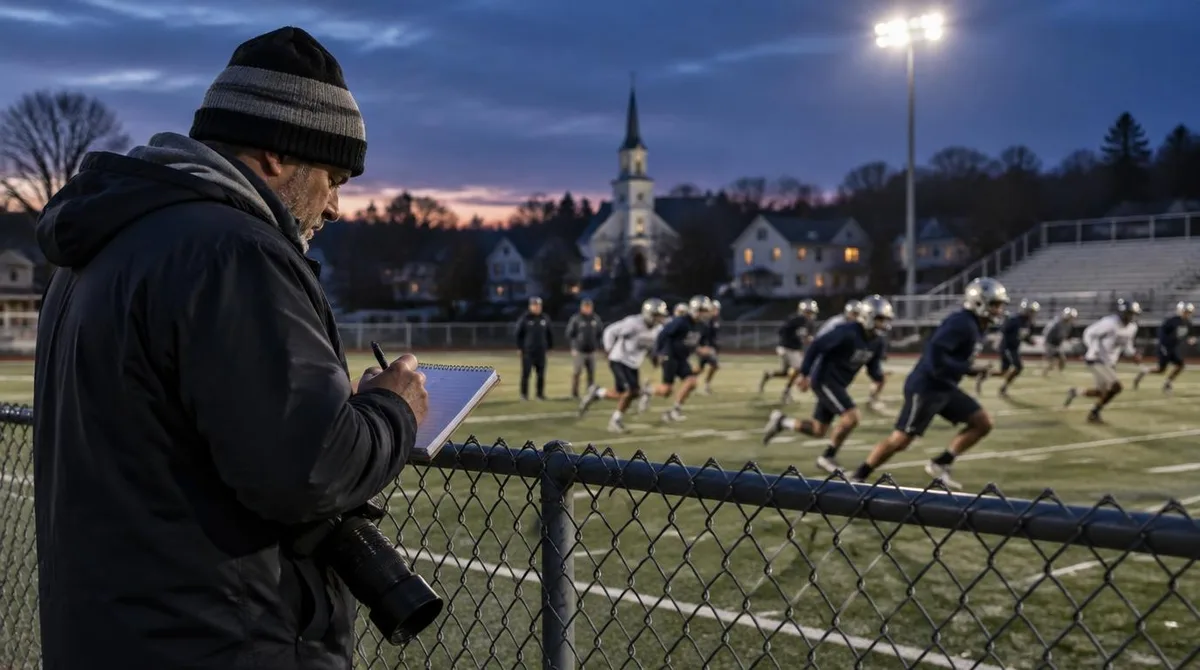
Local sports news matters because most athletic careers happen far from a national camera. A regional desk is often the only place that records a high school sectional final, a college recruit's signing, or a masters swimmer's comeback. When that coverage disappears, the record disappears with it.
The case is easy to see in one small Massachusetts town. According to Patch Chelmsford, the town's local feed in recent weeks has carried items ranging from a wrong-way Route 3 crash that disrupted midday traffic to students who helped ban black plastic takeout containers in their schools. Sports sits inside that same mix — one item among many that only a hometown desk would think to write down.
This piece looks at what regional sports desks actually do, why national outlets rarely replace them, and what their decline means for the people who play, coach, and follow the games.
What does a local sports desk actually cover?
The short answer: everything a national outlet cannot afford to send anyone to. A regional reporter covers the Tuesday night game, the injury that reshapes a season, the coach who retired after twenty years, and the sophomore who just ran a personal best. None of these is a national story. All of them are the substance of a town's sporting life.
The work is unglamorous and cumulative. A single game story has limited value on its own. But a decade of them forms a record — who played, who improved, who got hurt, who came back. Recruiting services, college programs, and even families rely on that record, often without knowing where it came from. This connects to our earlier piece, NAC is back on supplement shelves. Here's what changed, and what didn't.
There is also an accountability function. Local reporters notice when a league changes its eligibility rules, when a facility budget gets cut, or when a safety policy stops being enforced. National coverage almost never reaches that level of detail.
Why don't national outlets fill the gap?
Economics, mostly. A national outlet monetizes attention at scale. A high school soccer match in one suburb draws a few hundred readers at best, and most of them already know the score. That math does not support travel budgets, so national desks cover the events with the widest possible audience: playoffs, championships, and athletes who are already famous.
Hyperlocal sites work on a different model. Their reporting is cheap to produce because the reporter lives ten minutes from the field, and their audience is small but loyal. The trade-off is resources. A one-person local desk cannot match the depth a national outlet brings to a single story. It compensates with presence — being at the game, knowing the families, remembering last season.
Neither model substitutes for the other. The national story explains what the result means for a sport. The local story explains what the result means for a town.
What gets lost when coverage thins out?
Three things, in rough order of how hard they are to replace.
- The record. Results, rosters, and milestones stop being documented anywhere. Athletes who are not already stars become invisible outside their own gym.
- The context. A town that reads about its own teams understands its own sports culture — which programs are well run, which are struggling, why. Without that, booster politics and rumor fill the space.
- The pipeline. Scouting at every level depends on someone having watched and written. When nobody writes, talented athletes in small markets get noticed later, or not at all.
There is a quieter loss too. Local coverage treats ordinary athletes as newsworthy, which is a statement about who a community counts. When the only athletes who get written about are professionals, the message to everyone else is that their seasons do not matter.
What this means for readers who follow the games
For readers, the practical picture is mixed. Hyperlocal coverage survives in many places, but its shape has changed. Town-by-town news sites now bundle sports with everything else — school board votes, road closures, community calendars — rather than running a dedicated sports section. The Chelmsford example is typical: athletics appear as one thread in a general local feed, alongside items like the town's data-center ban debate and a wandering black bear. The sports coverage exists. It just shares a desk with everything else.
That bundling has consequences worth naming honestly. A general-assignment reporter covering a football game on Friday and a zoning hearing on Monday will produce thinner sports analysis than a specialist would. Depth suffers even as presence survives.
The upside is durability. A site that does not depend on sports alone does not fold when sports advertising softens. For a small town, a general local desk that occasionally covers the game may be more sustainable than a sports-only outlet that cannot.
Our analysis: what to watch for
The healthiest signal in a local sports scene is not the size of the coverage but its continuity. A desk that shows up every week, in a losing season as reliably as a winning one, is doing the work that matters. Occasional feature stories on a feel-good run are not a substitute.
It is also worth reading local coverage with the same skepticism applied to national coverage. Small outlets face the same pressures to chase engagement, and a hometown reporter is not automatically immune to inflating a prospect or ignoring a program's problems. The corrective is the same at any level: check whether claims are attributed, whether losing programs get covered, and whether the reporter was actually at the event.
For athletes and families, the takeaway is straightforward. Local coverage is a civic infrastructure, and it responds to use. Results submitted, corrections offered, and attendance at games all feed the record that future recruiting, historical writing, and plain community memory will draw on. The desks that survive are the ones a town actually reads.
The broader sports conversation — doping rules, label claims, the supplement market — gets covered elsewhere on this site, including the wider sport-news section. But the entry point for most athletes is not a national headline. It is the write-up of a game someone bothered to attend. For related coverage, see FTC sends refund checks over unproven supplement health claims.
Where local sports coverage goes next
The likely future is not the death of local sports reporting but its continued absorption into general hyperlocal outlets, supplemented by team-run and league-run channels. Those channels are useful — first-party announcements are fast and accurate about their own events — but they are not journalism. A team will not break the story of its own budget crisis.
The open question is who pays for independent eyes at the game. Volunteer-run outlets, school journalism programs, and general hyperlocal sites each answer it partially. None answers it fully. What is clear is that the demand has not vanished: people still want to read about their own teams, in their own towns, in seasons that end without a trophy.