Combat sports weigh athletes before competition, and for decades that ritual has driven rapid weight loss — sauna sessions, fluid restriction, diuretic-adjacent products — that sports-medicine research documents as hazardous. Surveys of mixed martial artists and boxers report that large majorities cut weight rapidly before bouts, with magnitudes commonly around 5 to 10 percent of body mass in the final week, per the combat-sports literature. The reforms that followed — earlier official weigh-ins and walking-weight programs — are the subject of ongoing debate, and the evidence on both the harm and the fixes is now substantial.
24 News Click publishes information, not medical advice. Weight-cutting carries documented medical risk; decisions about weight classes belong with qualified clinicians and commission physicians.
What does rapid weight loss do to the body?
The research is unambiguous in direction. Studies of rapid weight loss in combat athletes, summarized in systematic reviews, report association with reduced plasma volume, impaired aerobic performance, degraded cognitive function and markers of kidney stress; case documentation in the medical literature links severe cuts to heat illness and, in extreme published cases, death. Dehydration is central: much of a rapid cut is water, and the brain is mostly water — the mechanism behind the concern, expressed in commission medical literature, that a dehydrated brain suffers more from the concussion combat sports deliver. Per the National Institutes of Health, hydration and electrolyte status are tightly coupled, and rapid loss of body water disturbs both.
Why did weigh-ins move earlier in the day?
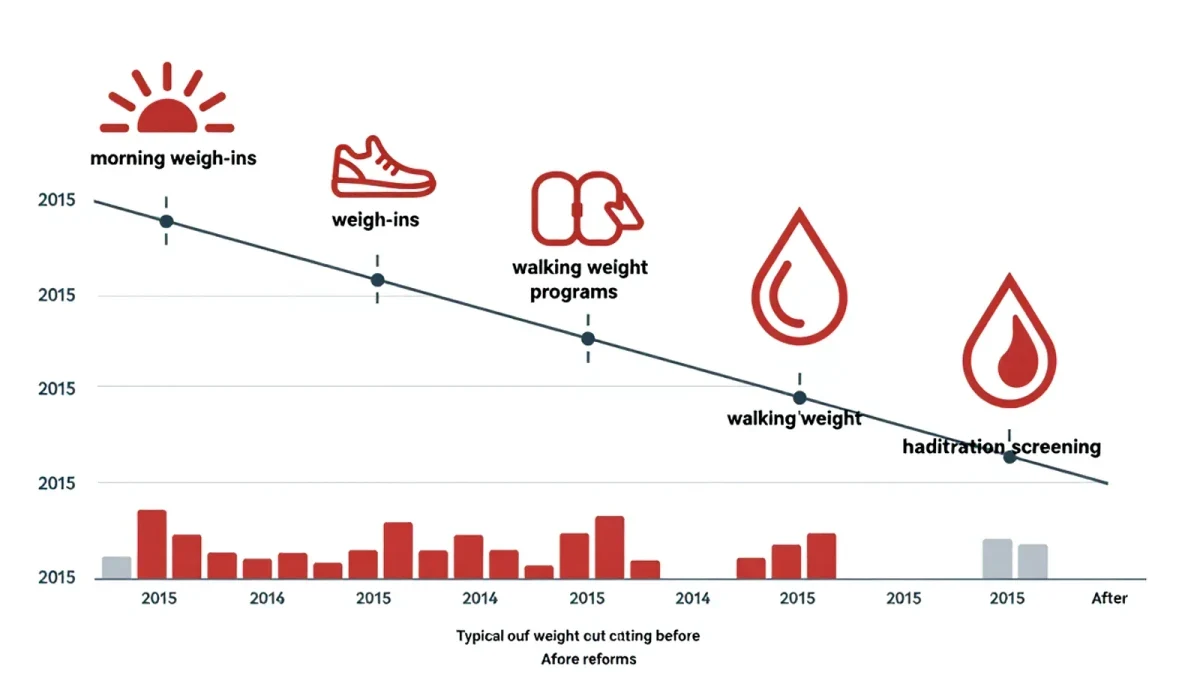
The same-day weigh-in, standard for much of boxing history, gave athletes hours, not a full day, to rehydrate — the reasoning being less cut would be attempted. The modern shift to same-day-early or day-before-evening formats came from opposite directions in the 2010s. Per commission records and contemporaneous reporting, the California State Athletic Commission moved its official weigh-ins to the morning in 2016, giving fighters roughly a full day to rehydrate after weigh-ins that previously occurred late afternoon. Promotions adopted the morning format on the logic that more rehydration time reduces the number of fighters competing while dehydrated — a compromise, not a cure: research on the reform finds it changed the rhythm of the cut rather than its size, with many athletes still cutting large percentages.
What is the walking-weight approach?
After a fighter death linked to weight cutting in late 2015, the promotion One Championship publicly scrapped extreme cutting and adopted a program built around athletes competing near their walking weight, with hydration testing used to screen dehydrated athletes out of their declared divisions, per the promotion's announced policy. UFC later introduced its own monitoring measures, and commissions including California have run voluntary programs tracking fighters across camps. Published evaluations of such programs are limited, and the independent research that exists on weight-management rules in combat sports reports mixed compliance — a finding worth stating plainly: no rule has yet eliminated rapid cutting, and athletes and camps still game whatever test is used.
Does the extra rehydration day help?
Partly, per the sports-science evidence. Rehydration and glycogen restoration research shows most fluid and much of the mass returns within 24 hours, but full restoration of performance measures can take longer — a documented gap between scale weight and physiological readiness. Critics of day-before weigh-ins, including commission medical advisers quoted in the boxing and MMA literature, argue the long window simply enables bigger cuts. The evidence lends support to both readings: fighters are less dehydrated at the bell than under same-day rules, and cuts have not shrunk accordingly.
What role do supplements and products play?
A problematic one, per anti-doping and medical documentation. Diuretics are prohibited in-competition under WADA rules and their use without a sanctioned medical reason is a violation; over-the-counter water-loss products and extreme sauna-based cutting remain outside anti-doping rules but inside the medical-risk zone described above. The IOC consensus on supplements documents contamination risk generally, relevant to fighters who are tested. Rehydration products after a cut are used widely; the evidence supports carbohydrate-electrolyte solutions for rehydration speed in the general sports literature, but no product makes a dangerous cut safe — the hazard documented in the case literature precedes the choice of recovery drink.
What did college wrestling change after 1997?
The most complete reform in weight-governed sport predates MMA's debates. After three collegiate wrestlers died in late 1997 following rapid weight-cutting, as documented in contemporaneous medical reporting, the NCAA and later high-school governing bodies rewrote the rules: pre-season weight certification including hydration testing and body-composition measurement, a calculated minimum wrestling weight below which athletes may not compete, and bans on practices such as rubber suits and excessive sauna use in published rules. Evaluations of those policies in the sports-medicine literature report reduced extreme cutting at the collegiate level — evidence that combat sports at large cite when arguing for similar certification, per commission and medical publications.
How much weight do fighters regain before the bell?
Studies of professional fighters report body-mass regains of roughly 5 to 10 percent between the official weigh-in and competition, an attributed range from the combat-sports literature. The performance question behind the number is less settled: research findings on whether the larger man in the cage wins more are mixed, with some studies reporting no clear advantage to bigger cuts and case-series evidence associating rapid regains with documented medical risk rather than benefit. Weight missed outright carries its own documented consequences — fines, forfeited titles and bout cancellations — which commissions publish as deterrents, per commission records. The honest summary of the literature: the cut persists because camps believe it pays, and the evidence for that belief is thinner than its costs are documented.
Do commissions test hydration at weigh-ins?
Some now do, and the results are instructive. Commission-run programs, including California's, have used urine specific gravity — a concentration measure — to screen for dehydration at official weigh-ins, per commission policy documentation, with athletes flagged as dehydrated in some protocols required to be cleared by a physician before competing. Published descriptions of such programs report a recurring finding: a meaningful share of fighters arrive at weigh-ins still measurably dehydrated despite the rehydration-day reform, which quantifies the criticism that earlier weigh-ins moved the problem rather than shrinking it. Proponents answer that the screening at least catches the extreme cases before they reach the cage, per commission statements — the measurable health floor, if not the solution, the combat-sports medical literature has long called for.
What would evidence-first reform look like?
The published medical literature on weight cutting converges on a short list: weight certification before the season with hydration and body-composition measurement, on the NCAA model with its documented reduction in extreme cutting; multiple random weigh-ins across a camp rather than a single official reading; meaningful consequences for misses already present in some promotion contracts; and medical clearance tied to measured dehydration rather than scale weight alone. Surveys of athletes and coaches, summarized in combat-sports research, indicate support for safer rules paired with skepticism that rivals will follow them — the collective-action trap the literature names explicitly. The NCAA precedent is the counterexample that keeps the reform argument alive: rules enforced across a whole sport, the evidence shows, can move culture where individual incentives do not.
Where does reform go from here?
Directions discussed in commission and medical publications include more weight-class divisions to shrink the incentive, camp-long weight monitoring with competition bans for repeated misses — some promotions already impose these — and hydration screening at weigh-ins. The research consensus that has formed is modest and firm: rules shape the cutting calendar, and only cultural change in camps, backed by medical supervision, shrinks the cuts themselves. Per survey research, athletes cut because they believe it wins bouts; until that belief is outweighed by enforcement and education, the reform project stays unfinished.