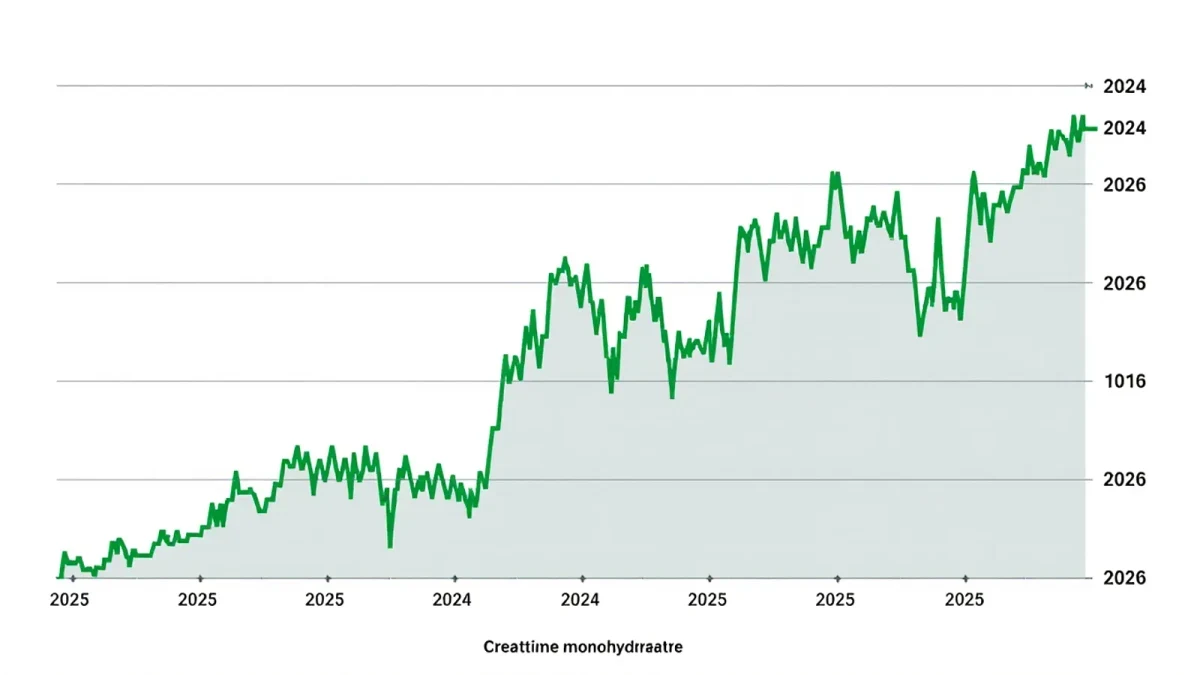
The creatine market has moved from scarcity to surplus. Per industry price analyses of Chinese monohydrate production, the raw-material price that peaked near RMB 41,600 per ton during the 2024 shortage had fallen to roughly RMB 20,500–24,000 per ton across 2025 as new capacity came online. At the same time, per NutraIngredients, January 16, 2026, the number of European brands offering creatine gummies grew by 48 percent, as demand shifted toward confectionery formats.
Format and price changes say nothing about what any individual should take.
What changed in supply?
The 2024 spike was a capacity problem: creatine monohydrate manufacturing is concentrated in a small number of Chinese producers, and surging global demand — driven in part by mainstream wellness adoption beyond sport — collided with limited output. The subsequent price decline through 2025 reflected new production capacity and oversupply, per the same industry price analyses. Market researchers at Grand View Research estimated the retail creatine supplements market at roughly 1.4 billion US dollars in 2025, with continued growth projected.
For consumers, the practical consequence appears in retail pricing and availability: the shortages and sharply rising per-serving costs of 2024 have, per industry trackers, largely subsided as of early 2026, though analysts note input costs, including energy, could drive renewed adjustment.
Do gummies change the product, or just the package?
Both, and the second part is the caution. Per the NutraIngredients reporting of January 16, 2026, gummy launches are expanding rapidly, and the publication quoted industry voices expecting 2026 to eliminate unsustainable gummy strategies — products whose formulation cannot deliver stable creatine content. Creatine monohydrate itself is among the most-studied sports-nutrition ingredients; per the NIH Office of Dietary Supplements, trials support certain performance effects in specific exercise contexts. But a gummy is a delivery format with its own stability and dose-accuracy questions, and a label's creatine claim is a manufacturer's claim until verified. Third-party batch certification remains the main consumer check, regardless of format.
The market signal is straightforward: cheap monohydrate powder and a widening shelf of premium-priced gummies now coexist, and the price gap between them reflects manufacturing and marketing, not differences in the underlying evidence.
What a buyer can verify remains unchanged regardless of market conditions: the ingredient's evidence base attaches to creatine monohydrate itself, batch certification screens for label accuracy, and per-serving cost math is now favorable enough that price is a weaker excuse than it was in 2024. The market data describe availability, not need — a distinction worth keeping even in a calm market.
and the price gap between them reflects manufacturing and marketing, not differences in the underlying evidence.