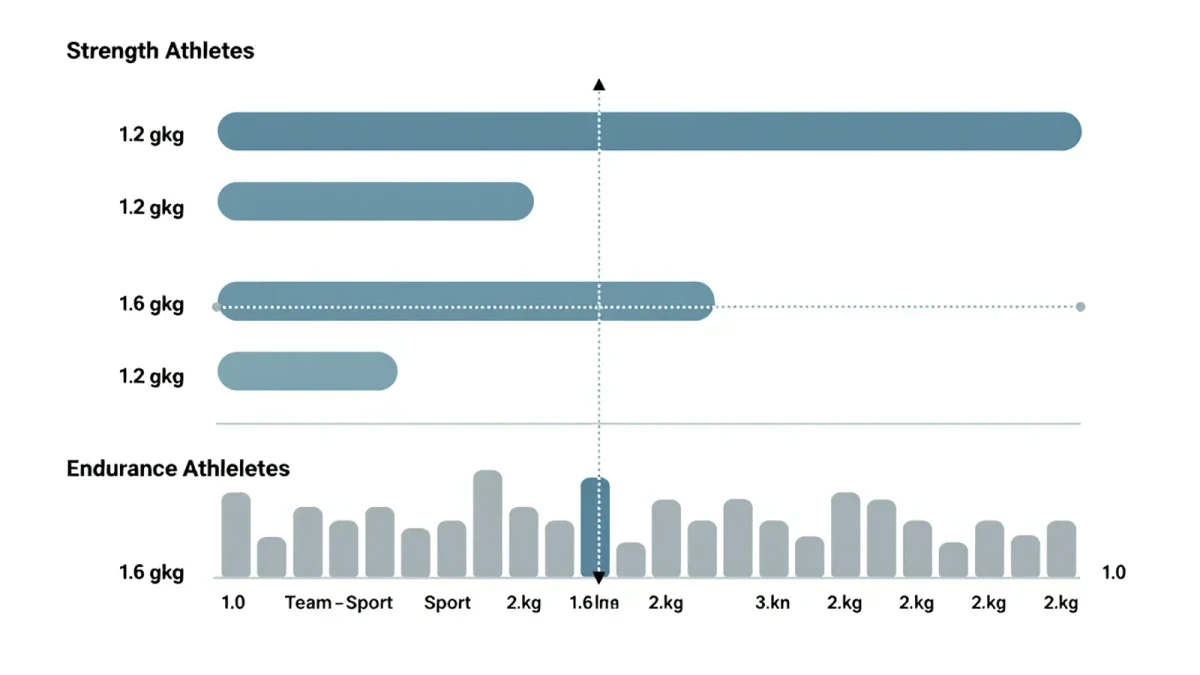
Athletes need more protein than sedentary adults, and the most defensible numbers come from two documents: the 2016 joint position stand of the Academy of Nutrition and Dietetics, Dietitians of Canada, and the American College of Sports Medicine, which recommends 1.2 to 2.0 grams per kilogram of body weight per day for athletes, and a 2018 meta-analysis of 49 trials by Morton and colleagues, which found muscle gains plateau around 1.6 grams per kilogram. Both are summaries of studies in training adults, not prescriptions for any individual.
24 News Click publishes information, not medical advice. Personal protein targets, particularly for people with kidney or liver conditions, belong with a qualified clinician or sports dietitian.
Why do athletes need more protein than sedentary adults?
The recommended dietary allowance for sedentary adults is 0.8 grams per kilogram per day, a number designed to prevent deficiency, not to support training. Exercise both breaks down muscle protein and sensitizes muscle to protein from food, so athletes need extra amino acids to repair damage and build new tissue.
The joint position stand set the athletic range at 1.2 to 2.0 grams per kilogram per day, noting that strength athletes looking to maximize muscle gain sit toward the top of the range and endurance athletes, who burn some protein as fuel during long sessions, sit in the middle. A 2011 review by Phillips and Van Loon reached a similar conclusion, arguing the evidence pointed well above the RDA for anyone training hard.
What did the 2018 meta-analysis find?
A 2018 meta-analysis by Morton and colleagues, published in the British Journal of Sports Medicine, combined 49 controlled trials with more than 1,800 participants doing structured resistance training. It found that protein supplementation increased lean mass and strength, but the benefit flattened as total intake rose, with the break point at roughly 1.6 grams per kilogram per day. The confidence interval around that break point extended to about 2.2 grams, meaning some individuals may retain a small benefit higher up.
The analysis also found that protein timing around workouts mattered far less than total daily intake. That finding matches earlier reviews concluding that the much-discussed anabolic window is secondary to simply eating enough protein across the day.
Do strength and endurance athletes need different amounts?
The ranges overlap more than gym folklore suggests. Strength and power athletes often aim near or above 1.6 grams per kilogram to support muscle gain, while endurance athletes typically land between 1.2 and 1.6 grams per kilogram, partly because long sessions burn protein for energy and increase repair needs. Team-sport athletes, who mix sprinting, contact, and endurance demands, generally sit between the two.
There is little evidence that going well beyond 2.0 grams per kilogram adds muscle. The Morton meta-analysis found no further benefit above its break point, and the position stand states the top of the range is a ceiling of the evidence, not a goal. Excess protein beyond need is largely oxidized for energy.
How much protein should one meal contain?
Trials using traced amino acids suggest roughly 0.4 grams per kilogram per meal maximizes the muscle-building response in younger trained adults, which works out to about 20 to 40 grams of quality protein at each of three to five meals. A 2015 analysis by Moore and colleagues estimated the per-meal ceiling near 0.4 grams per kilogram, beyond which extra protein added little to muscle protein synthesis.
Older athletes appear to need more per meal. Studies in older adults by Moore's group and others found a smaller muscle response to a given dose, consistent with the anabolic resistance of aging, which is why many sports dietitians place masters athletes near the top of the daily range and favor larger single meals.
Does protein timing matter?
Total daily protein matters most, and the evidence for precise timing is weak. The 2018 Morton meta-analysis found no significant effect of protein timing on gains when total intake was matched. What does survive scrutiny is distribution: muscle protein synthesis responds meal by meal, so spreading protein across the day at roughly three- to five-hour intervals makes physiological sense even if the payoff is modest.
The pre- and post-workout window, heavily marketed since the 2000s, does not show a reliable independent effect in trained adults eating enough total protein. A 2013 review by Aragon and Schoenfeld concluded any timing effect is small compared with daily totals.
Can someone eat too much protein?
In healthy adults, high-protein diets up to about 2.2 grams per kilogram have not shown harm in trials lasting up to a year, including a 2016 study by Antonio and colleagues in resistance-trained men. Those trials are industry-funded in part, small, and short, which limits how far the conclusion can be pushed.
People with kidney disease are a different population entirely, and protein restriction is part of managing some kidney conditions. The National Institutes of Health maintains general protein background information, and anyone with a diagnosed condition should treat protein targets as a clinical question, not a sports one.
Where should the protein come from?
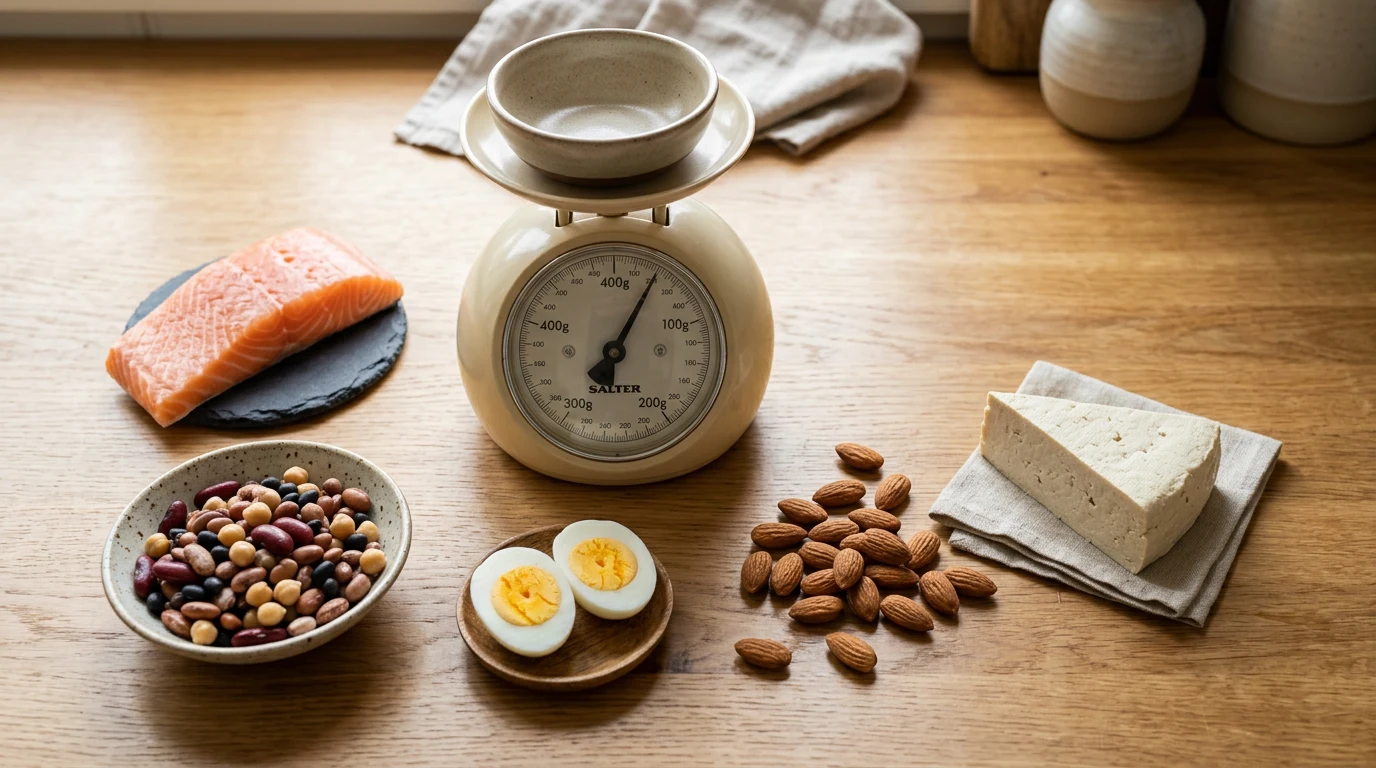
The position stand emphasizes food first, with supplements as convenience rather than necessity. Complete proteins — those containing all essential amino acids in useful amounts, such as meat, fish, eggs, dairy, soy, and blends of plant foods — make hitting per-meal targets easier. Leucine, an amino acid that triggers muscle protein synthesis, is the nutrient of interest; animal proteins and dairy tend to be richest in it.
Plant-based athletes can reach the same totals but usually need slightly larger portions, because plant sources carry more calories per gram of protein and slightly less leucine. This is a planning problem rather than a biological barrier, as the 2016 position paper of the Academy of Nutrition and Dietetics on vegetarian diets concluded.
What does the evidence not show?
The evidence does not show a single optimal number for every athlete. It shows a plateau in the dose-response curve near 1.6 grams per kilogram for muscle gain in resistance trainees, a wide valid range for health and performance, and no magic in timing. Anyone claiming exact figures beyond that is extrapolating beyond the trials.
FAQ
Is 1 gram per kilogram enough when training hard?
Probably not. That sits below the 1.2 to 2.0 gram per kilogram range in the 2016 joint position stand, and below the roughly 1.6 gram per kilogram plateau found in the 2018 Morton meta-analysis. Most training adults land comfortably above 1 gram per kilogram from ordinary food alone.
Do protein needs change while losing weight?
Likely yes. Muscle is lost during caloric restriction, and studies of protein during weight loss, including trials in athletes reviewed by Helms and colleagues, suggest the upper part of the range helps preserve lean mass. Those trials are mostly in bodybuilders and weight-class athletes, so the exact figure varies by person and sport.
Are protein supplements necessary?
No. The position stand frames powders as convenience. Milk, eggs, meat, fish, legumes, and soy foods can cover athletic ranges, and shakes mainly make the arithmetic easier on heavy training days or tight schedules.