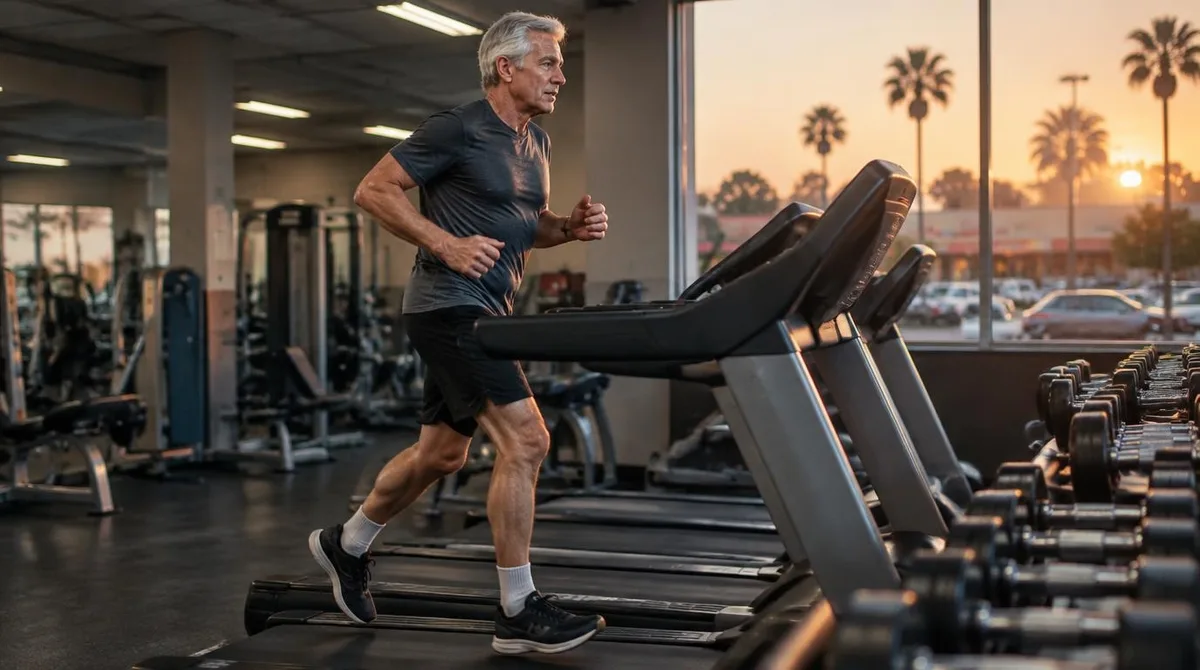
Seb Coe, the president of World Athletics, keeps fit by running on a treadmill at a 24 Hour Fitness in suburban Southern California. According to 3 Wire Sports, his membership there costs $28 a month, and the gym puts it on hold when he is away so he pays only for what he uses. He is 70 years old and ticks off 10-minute miles, for an hour, several days a week.
That detail matters less as celebrity gossip than as a picture of what long-term training actually looks like. Coe won four Olympic medals, two of them gold, and set an 800-meter world record of 1:41.73 that stood for 16 years and still ranks No. 6 all time. Four decades later, his routine is not exotic. It is a treadmill, a cheap gym, and a fixed time slot built around his calendar.
For anyone interested in fitness, the instructive part is the fit between routine and life, not the machinery. Coe's setup works because it removes friction, and friction is what kills consistency.
Why does a billionaire-adjacent executive train at a budget gym?
Because it fits his schedule, not his image. Per the 3 Wire Sports report, Coe is in California ahead of the LA28 Games and works on European time, up before dawn around 4 a.m. for calls. He described the adjustment as a "different lifestyle," the "American dream of eating supper at 5:30 at night and being asleep by 8 o'clock." That puts him at the gym by about 6:30 in the morning, with free parking right outside the door.
The economics in the report are striking. Equinox memberships run near 10 times his $28 monthly fee. In London, Coe holds a lifetime membership at a high-end gym he secured decades ago through promotional work, where top-tier membership costs about $20,000 a year. In Monaco, where World Athletics is based, he uses a beachfront gym. In California, he chose the cheap option because it was open, local, and unbothered.
What does the anonymity at his gym tell us?
That the best training environment is often the one where nobody is watching. Per the report, no one at his 24 Hour Fitness knows who he is. Some members ask whether he has been on a treadmill before. A few people his vintage give him a double look, as if they ought to place him but cannot.
There is a practical lesson in that. Gyms built around being seen — the report contrasts 24 Hour Fitness explicitly with the Equinox crowd — add a performance layer to training that has nothing to do with training. A place where "people do not typically go there to see or be seen," as the report puts it, strips that away. For a 70-year-old doing an hour of steady treadmill work, that is exactly the point. The session is aerobic maintenance, not spectacle.
Is his routine a recovery strategy?
It is closer to load management than recovery. The report describes steady running, not hard intervals, from a man who turned 70 at the end of September. Long, easy aerobic work at that age is joint-friendly and sustainable, which is precisely why it survives decades. It sits on the easy end of the spectrum covered in active recovery or complete rest — the question of whether light movement serves the body better than full shutdown. For related coverage, see Active recovery or complete rest: which works better?.
What the report does not describe is any supplement stack, gadget, or protocol. No cold plunge, no compression boots, no powder. For a publication that spends a lot of time on recovery products, the absence is itself a finding worth sitting with.
What does the early-morning schedule reveal?
That his routine is built around sleep timing, not against it. Coe is awake at 4 a.m. because of nine-hour time zone math, asleep by 8 p.m., and training mid-morning by his body's standard. The report frames this as him adapting to California; the structure resembles what sleep hygiene for early-morning training tries to solve — anchoring sleep, meal timing, and training into a coherent block rather than fighting the clock. We covered a connected angle in Sleep hygiene for early-morning training: what helps at 5 a.m..
He is not squeezing workouts into a depleted evening. The gym slot sits in a window his schedule protects. That is a design choice most busy people get backwards.
Does the gym's own story matter here?
It adds context on how fast the fitness industry turns over. Per the report, 24 Hour Fitness sponsored the U.S. Olympic team from 2004 to 2008 and appeared on NBC's "The Biggest Loser," where 2000 Greco-Roman wrestling gold medalist Rulon Gardner dropped from 474 pounds to 289 — his Olympic weight — in Season 11. Then, during the pandemic, the chain went through bankruptcy and shed more than 200 outlets.
A company that once sponsored Olympians now survives on $28 memberships in the suburbs. Coe called the whole arrangement "quintessentially America." The durability lesson cuts both ways: flashy fitness brands come and go, and the plain treadmill in the plain gym outlasts them.
What should readers actually take from this?
That the evidence here is anecdotal — one man's routine, reported in one profile — and it should not be oversold. But it aligns with what sustained athletic longevity tends to look like from the outside: modest, repetitive, scheduled, and cheap enough that nothing about it can become an excuse. Coe's trophies are in the past. The 10-minute miles at 6:30 a.m. are the current record, and they are set by showing up.