The marathon's decisive physiology is fuel arithmetic: studies of marathon running, from classic glycogen-depletion research to modern racing analyses, show runners who exhaust stored carbohydrate slow sharply in the final quarter of the race — the documented phenomenon behind hitting the wall. This is why elite fields at the World Marathon Majors — the series that includes Boston, London and Berlin — now publicly discuss high carbohydrate intakes during races, and why international consensus statements on endurance nutrition describe in-race carbohydrate as one of the best-evidenced performance interventions in distance running.
24 News Click publishes information, not medical advice. Race-day nutrition plans, particularly for runners with health conditions, belong with qualified clinicians and sports dietitians.
Why does the wall happen?
Muscles run largely on a mix of fat and carbohydrate, and carbohydrate is the faster fuel at race pace. Classic exercise-physiology research established that stored muscle glycogen — carbohydrate in the muscle — typically lasts around 90 minutes to two hours at marathon effort in unadapted runners, while fat carries far more energy but releases it more slowly. When glycogen runs low, pace falls to what fat alone can support. That is the wall, and every fueling strategy at the majors exists to delay it: start with full stores and take in carbohydrate while running.
How much carbohydrate do elite marathoners take in?
Modern elite practice, reported by athletes and coaches in major-marathon coverage and documented in sports nutrition research, has climbed to intakes of roughly 90 to well over 100 grams of carbohydrate per hour in some leading programs — far above the roughly 30 to 60 grams per hour supported by older single-source guidelines. The research basis is a body of controlled trials showing that mixtures of glucose and fructose are absorbed through multiple intestinal routes and can raise total absorption above what glucose alone allows, a finding summarized in international consensus statements. Two caveats belong with that: individual responses vary widely, and the upper figures are attributed observations of what studied elite programs did, not recommendations.
Why is practicing fueling part of training?
Because the gut is trainable and untrained guts rebel. Sports-gastroenterology research documents that repeated carbohydrate feeding during training increases intestinal absorption capacity and reduces gastrointestinal distress — the practice teams call gut training. Marathon studies consistently report gastrointestinal complaints as a leading reason racers underperform or drop out, and tolerance of 90 grams per hour is built over weeks, not adopted on race morning. This is the single most transferable finding for recreational marathoners: whatever products a runner plans to use at a major, the evidence says to rehearse them at race intensity in training, because absorption at marathon pace differs from absorption at a jog.
What about carbohydrate loading before the race?
Carbo-loading has real evidence behind it, with an important historical correction. The old depletion phase — days of very low carbohydrate followed by a gorge — dates to 1960s research and has been superseded: modern consensus statements describe a simpler protocol of one to two days of high carbohydrate intake with tapered training, which per the research restores glycogen about as effectively without the misery and the performance cost of depletion. Studies underlying those statements measured glycogen content and time-to-exhaustion outcomes in trained runners.
Do fluids and sodium matter at the majors?
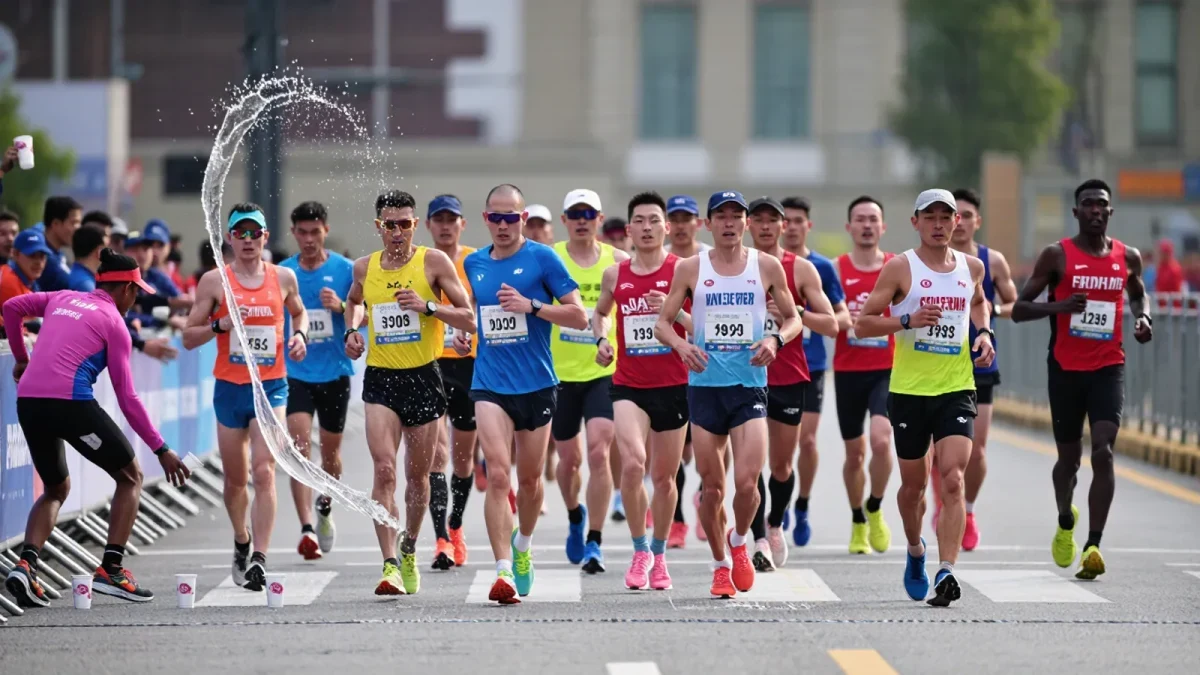
Yes, and differently by race. Sweat-rate studies in marathoners report typical losses near 1 to 1.5 litres per hour in temperate conditions and more in heat — relevant because Boston and Chicago have seen warm editions, per event weather records, while London and Berlin are typically cooler. Per the National Institutes of Health, sodium is the principal electrolyte lost in sweat, and sports-nutrition position supports sodium-containing fluids for heavy sweaters over long hot races. The documented counter-risk is over-drinking plain water to the point of diluting blood sodium, which marathon-medicine literature identifies as a recognized, occasionally severe, race-day hazard — another reason major marathons staff medical teams and publish drinking guidance framed as ranges, not rules.
What does caffeine add?
Caffeine is among the best-evidenced ergogenic aids in endurance sport, with meta-analyses showing average performance improvements in time-trial and endurance contexts, including running studies. Per the IOC consensus on supplements in elite athletes, it sits on the short list with strong evidence, with documented individual variability in side effects. Marathon use is widespread and permitted; the evidence note that matters most to a four-hour runner is timing — a dose taken at the start line peaks well before the finish, which is why some elites re-dose mid-race under team protocols, an attributed practice.
What do elites drink on course?
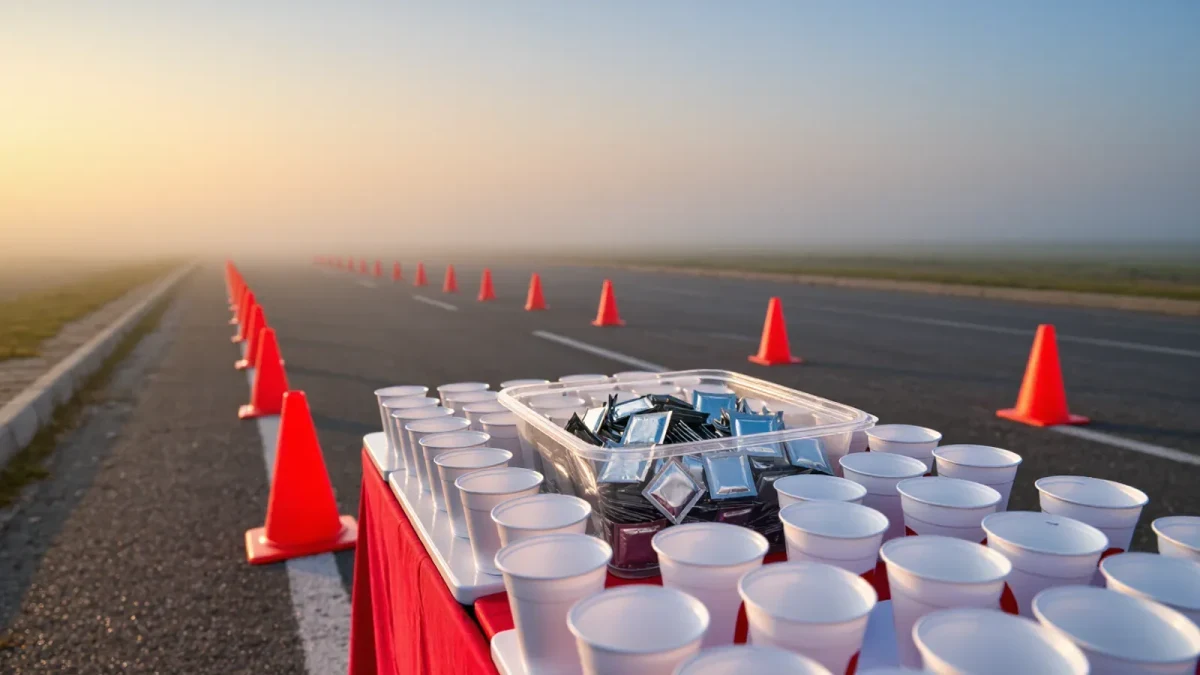
At the front of a major, the documentary practice is personal bottles, prepared by team staff and placed on tables at assigned stations, holding each runner's practiced mix. Sports-nutrition research on elite marathon fueling reports drinks concentrated well above the 6 percent carbohydrate of a standard sports drink — mixed glucose-fructose solutions approaching 10 to 15 percent in documented elite practice — tolerable because the athletes have trained the gut to handle them, per the same absorption studies behind the multi-source guidance. Mid-pack runners work from the same physics with communal tables: whatever the product, the evidence says rehearse it first, because a solution too concentrated for an untrained gut sits in the stomach rather than reaching the muscles.
How do majors handle warm-weather editions?
Race organization is part of the physiology. The major marathons publish event-day alert systems — color-coded flags reflecting conditions from ideal to extreme — and have shifted start times earlier or expanded medical coverage in documented hot editions, decisions race-medicine teams make against published heat guidelines for mass-participation running. The medical literature on marathons in heat reports increased rates of heat illness and higher dropout at warm editions, which is the evidence behind the operational rules. For runners, the documented implications are pace realism — heat slows the achievable pace at every distance, a finding consistent across laboratory and field data — and conservative drinking, since slow hot runs are where over-drinking cases concentrate.
Do sodium supplements prevent cramps in marathons?
The evidence is weaker than race-weekend folklore suggests. Exercise-associated muscle cramping has two main documented models in sports-medicine research — electrolyte depletion and neuromuscular fatigue — and reviews treat marathon cramping as most often fatigue-pattern, which sodium before or during a race does not prevent. Trials testing sodium supplementation against placebo in endurance events have generally found no reduction in cramp incidence, per published reviews, though replacing large measured sweat sodium losses remains reasonable practice for heavy salty sweaters on long hot efforts. The practical, evidence-aligned reading for runners: sodium serves fluid balance, not cramp insurance, and a cramp in the final miles is more often a pacing and training problem than a salt problem.
What does the evidence not support?
No good evidence supports ketone-ester dosing as an established race-day practice — trials exist but findings are mixed and inconclusive per current reviews — nor fat-adaptation as a race-pace strategy for elite performance, which controlled trials show degrades the ability to use carbohydrate efficiently. The marathon evidence hierarchy is stable: fill the tank, feed during, practice the feeding, manage fluids to the weather.
The majors make fueling visible — bottles on tables, gels at the front of the pack — but the underlying finding predates the era: the marathon pays whoever arrives at 30 kilometres with carbohydrate still in the account.