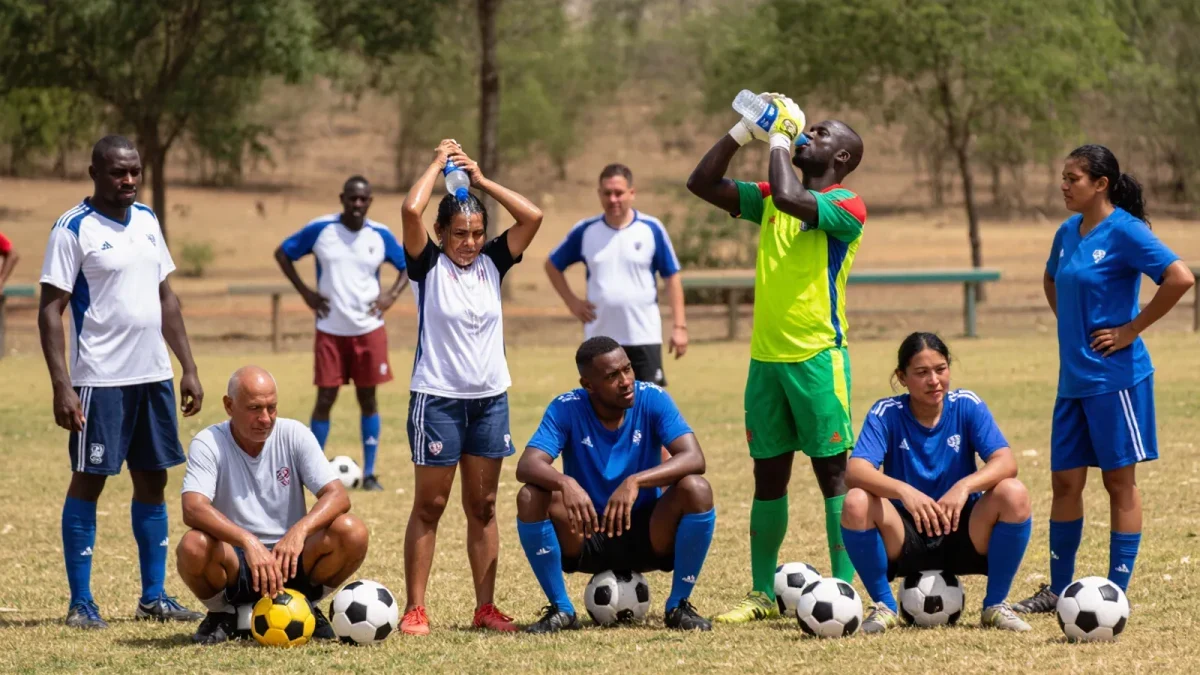
Football is a stop-start sport played in two 45-minute blocks, and in summer heat that structure produces a specific physiological problem: high-intensity efforts generate heat faster than rest periods shed it. Match-weighing studies — researchers weighing players before and after games — typically report body-mass losses of about 1 to 3 kilograms across 90 minutes in warm conditions, with some heavier positions and hotter matches exceeding that, per the soccer thermoregulation literature. What that loss does to performance, and what drinking does about it, is where the evidence gets precise.
24 News Click publishes information, not medical advice. Heat illness is a medical emergency category; individual hydration plans belong with qualified clinicians.
Does dehydration actually slow footballers down?
The research answer is: measurably, past a threshold. Laboratory and field studies summarized in sports medicine reviews indicate that a body-mass loss around 2 percent is where endurance capacity, sprint repeatability and decision-making begin to show degradation, though effect sizes vary between studies, and acclimatized players in real matches show smaller impairments than laboratory subjects. Notably, football-specific research has found players can finish professional matches in hot conditions with significant fluid deficits; the sport's structure limits intake opportunities, which is exactly the gap cooling-break policies at major tournaments address.
Why sodium, and why individuals differ?
Sweat carries sodium out of the body, and the National Institutes of Health identifies sodium as the principal electrolyte lost in sweat. Sports medicine testing across athletes reports sweat sodium concentrations ranging from roughly 200 to more than 2,000 milligrams per litre — a tenfold spread between individuals. This is why elite clubs run sweat tests and build player-specific plans: two defenders of similar size can lose very different amounts of sodium in the same match. For the general population, NIH notes typical diets already exceed sodium requirements; the case for sodium in football is about replacing match losses in heavy sweaters, not adding sodium on top of adequate intake.
How much can players drink during a match?
Less than they lose, and that gap defines match hydration. The literature describes gastric emptying and gut absorption as the bottleneck: the gut processes fluid at a finite rate, and drinking beyond it causes discomfort rather than hydration. Practical match-day practice documented in the soccer science literature follows from that: pre-match hydration to start near euhydration — normal water balance — small tolerated volumes at stoppages, and a recovery window afterward where appetite and thirst catch up. Half-time allows the largest single intake, which is also when the risk of over-drinking plain water appears; the documented hazard of diluting blood sodium is rare in trained players but real in extreme cases.
What works before match day?
Heat acclimatization has the strongest evidence base of any heat intervention in exercise physiology: one to two weeks of training in heat produces earlier sweating, greater sweat volume, expanded plasma volume and lower heart rate at a given workload, per decades of controlled studies. Acclimatized players sweat more, so their fluid needs rise. Pre-cooling — cold-water immersion or ice slushies before kickoff — shows modest documented benefits for performance in hot conditions in reviews, though effects are smaller in field settings than labs. kit choice matters too: the research on clothing and heat stress consistently finds lighter, more breathable kit reduces heat storage.
What do electrolyte products add?
For most recreational players in moderate conditions, the evidence supports water and food as sufficient, with sports drinks offering documented benefit mainly during long, hot matches for heavy sweaters — both by replacing sodium and by increasing voluntary drinking through palatability, a documented effect in the hydration literature. Beyond that, the market outruns the data: no good evidence supports oxygenated waters, alkaline waters or trace-mineral concentrates for football performance. The comparison that matters is between a drink's sodium content and the player's measured losses, which is a laboratory question, not a label-claim question.
How does half-time intake work?
The 15-minute interval is the largest single drinking window in a match, and the soccer science literature treats it accordingly. Players typically take fluids and sometimes light carbohydrate in the dressing room, and the documented risk at this pause is the opposite of the match's overall problem: gulping large volumes of plain water can leave a sloshing stomach and, in extreme cases seen more often in recreational events than professional football, contribute to dilution of blood sodium. The research-aligned pattern attributed in the literature is moderate volumes, continued at stoppages in the second half, with heavy sweaters adding sodium-containing drinks per individual plans built from sweat testing.
Does extra time change the calculus?
Yes, in tournament football that runs to 30 added minutes plus stoppages. Fatigue research on extended matches documents deeper glycogen depletion, larger fluid deficits and rising cramp incidence in extra time, which is why competitions permit an additional drinks break in extra periods of knock-out games — a rule documented in international competition regulations. The physiological logic is the same as for the standard 90 minutes, simply with less margin: players who arrive at the 90th minute already carrying a deficit are the ones the added time exposes.
What about youth and recreational players?
The pediatric exercise literature documents that children sweat less per hour than adults, acclimatize to heat more slowly and heat up faster for a given effort in some conditions — differences that make adult templates a poor fit. Youth football guidance from sports-medicine bodies emphasizes longer and more frequent breaks, shade access and drinking opportunities built into sessions rather than left to thirst, with organized pre-cooling and electrolyte products rarely relevant. For adult recreational players, the same basic evidence applies as in the professional game, minus the sweat testing: start hydrated, drink at breaks, respect the heat scale of the day, and know the emergency signs.
Can pre-cooling help before kickoff?
The laboratory evidence says modestly yes. Reviews of pre-cooling — cold-water immersion, ice vests or ice slushies taken before exercise in the heat — report small improvements in subsequent endurance performance, with effects larger in controlled settings than in messy field conditions like real matches. The mechanism is documented and simple: starting with a lower body heat reserve delays the point at which cumulative heat storage begins to impair output. Practical adoption at elite level is visible in hot-weather tournaments, where teams have used cooling garments and shaded warm-up areas, per event coverage. For most players, the evidence order remains acclimatization first, hydration second, pre-cooling as the final margin on genuinely hot days rather than a substitute for the first two.
When is heat a medical event?
Confusion, stumbling, cessation of sweating or collapse in heat signals possible heat stroke, which exercise-medicine guidance treats as a life-threatening emergency requiring immediate cooling and medical care — not a drinking problem to walk off. Leagues and federations have adopted wet-bulb globe temperature thresholds for delaying or modifying play precisely because this line exists, and football's own tournament rules now include mandatory hydration breaks at summer events.
The evidence-bottom line for football in heat is unromantic: acclimatize in advance, start hydrated, drink what the gut tolerates at stoppages, replace salt if testing says it is lost, and treat the red-flag symptoms as medicine's job, not nutrition's.