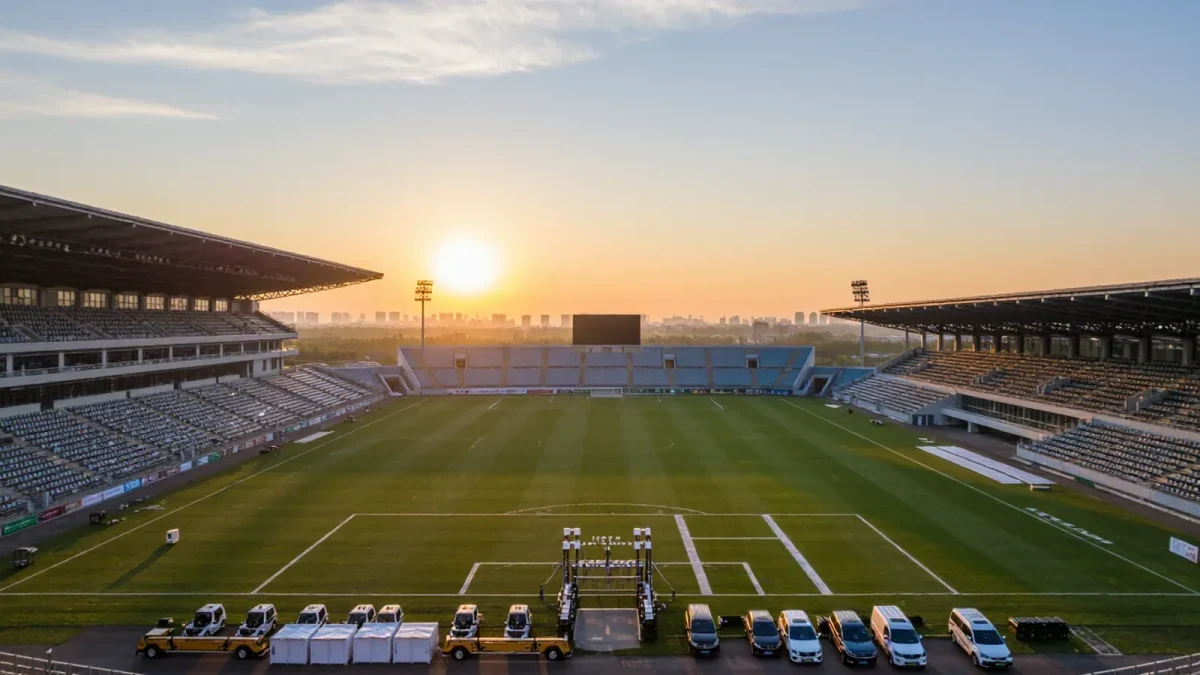
FIFA announced in December 2025 that players at the 2026 World Cup, scheduled for 11 June to 19 July 2026 across the United States, Mexico and Canada, will get three-minute hydration breaks midway through each half of every match — a first for the tournament, per FIFA. The reason is the calendar: a peer-reviewed 2025 analysis of heat risk at all 16 host venues, published by researchers including Mullan and colleagues, concluded that afternoon kickoffs carry the greatest extreme-heat risk. Understanding what heat does to footballers explains the policy.
24 News Click publishes information, not medical advice. Heat illness is a medical emergency category; individual hydration and heat plans belong with qualified clinicians.
How much fluid does a footballer lose in a hot match?
Studies of elite and sub-elite soccer matches in warm conditions typically report body-mass losses of roughly 1 to 3 kilograms over 90 minutes, with values above that in extreme heat — figures from the soccer thermoregulation literature, where losses are measured by weighing players before and after matches. A loss of about 2 percent of body mass is the point where the research begins to show measurable performance effects, including degraded endurance and decision-making, though findings vary across studies and some show smaller effects in well-acclimatized players.
What is in the sweat, besides water?
Sweat contains sodium, and the amount varies widely between individuals: sports medicine testing reports sweat sodium concentrations ranging from around 200 to more than 2,000 milligrams per litre. Per the National Institutes of Health, sodium is the main electrolyte lost in sweat and is central to fluid balance. This variation is why professional teams test players' sweat in laboratory or field settings and why a single drinking template cannot fit a squad. Heavier, saltier sweaters lose more sodium per match than lighter sweaters of the same body size.
What do the breaks actually do?
A three-minute stop allows drinking that would otherwise be limited to stoppages, and FIFA's stated rationale, per its December 2025 announcement, is player welfare across a 104-match tournament played in North American summer. The physiological logic is straightforward: drinking during exercise partly offsets the fluid deficit, and cooler break periods reduce cumulative heat storage slightly. What breaks do not do is fully replace losses — gastric emptying limits how much fluid can be absorbed, which is why the sports-nutrition literature frames match-day drinking as limiting the deficit rather than eliminating it.
Does kit and surface color matter?
More than intuition suggests. Research on clothing and heat stress consistently finds that lighter, more breathable garments reduce heat storage, and the radiative physics of dark surfaces in direct sun is well documented — one reason some competitions have moved summer matches to evening slots and venue design now treats shade and airflow as cooling instruments. Football's rules constrain what players wear, but the documented trend at hot-weather tournaments is toward white and light kits and cooler bench areas, per event operations guidance. None of this replaces drinking; it reduces the size of the problem drinking has to manage, which is how heat policy is meant to work — as a stack of small margins rather than a single fix.
Does altitude or travel change football hydration?
Tournament football adds variables club seasons rarely stack together: long flights, time-zone shifts and, at some 2026 venues, elevation. Air travel is documented in sports-medicine guidance as dehydrating — cabin air is dry and intake falls on travel days — so teams treat flight days as structured hydration work, per performance-staff practice. Mexico City's venues sit above 2,000 metres, where the altitude physiology documented for endurance events applies with full force to a 90-minute intermittent effort, and visiting teams have historically arranged early arrival for acclimatization, a practice dating to documented World Cup history. Neither factor requires exotic products; both reward the same planning habit the heat literature keeps confirming.
Does drinking more sodium help in the heat?
The evidence is more selective than marketing suggests. Sports nutrition position stands support sodium in fluids during long, hot efforts for heavy sweaters and for palatability — drinks with some sodium tend to drive more voluntary drinking, a documented effect. But sodium loading beyond replacing losses has not been shown to improve football performance, and the NIH notes most adults in the general population consume sodium well above requirements. Excessive plain-water intake without electrolytes carries its own documented risk, dilution of blood sodium, though this is rare in trained athletes over 90 minutes.
What about acclimatization?
Heat acclimatization — training in heat for one to two weeks — is among the best-evidenced interventions in exercise physiology, producing earlier sweating, more sweat, expanded plasma volume and better heat tolerance. Teams preparing for hot venues have used pre-tournament heat camps for this reason, a practice described in federation and club performance literature. Acclimatized players sweat more, not less, which raises rather than lowers fluid needs — a point the research is clear on and locker-room folklore often gets backwards.
What is wet-bulb globe temperature?
The number that governs hot-weather sport policy is wet-bulb globe temperature, or WBGT — a composite index that combines shade temperature, humidity, radiant heat from the sun and wind into a single figure of heat stress. It exists because plain air temperature understates risk: humid air stops sweat evaporating, and direct sun adds a large radiant load that a thermometer in the shade never sees. Governing-body heat policies, including the framework described in international football guidance, are built on WBGT thresholds — from simple drinking recommendations at moderate readings up to postponement or cancellation at the extremes, as the 2025 venue analysis for the 2026 tournament detailed. The device-level point matters too: WBGT is measured with a specific instrument at the pitch, not inferred from a weather app.
How do kickoff times change the risk?
Substantially, per the same 2025 analysis: afternoon kickoffs carry the greatest extreme-heat exposure because they combine the day's peak air temperature with strong sun, while evening kickoffs allow radiant heat to fall away. This is why tournament scheduling is itself a heat policy — venues with hot summer climates tend to be assigned evening slots in published fixture lists, a pattern visible in the 2026 tournament's published schedule. Players and teams also adapt preparation to slot time, per performance-team practice documented in the soccer literature: earlier pre-match hydration for midday games, pre-cooling where conditions warrant, and kit choices approved under competition rules.
What do players actually drink at the break?
Team-practice accounts and the sports-nutrition literature describe a short list: cool water, carbohydrate-electrolyte drinks, and in some cases chilled carbohydrate gels with water. The rationale is documented — cool fluids aid heat dissipation slightly and are drunk more willingly; carbohydrate matters because second-half glycogen depletion is a measured feature of professional matches; and sodium replaces what heavy sweaters lose. What the break window does not allow is meaningful food beyond gels, which is one reason the pre-match meal and the days before the match carry more of the fueling load than spectators might assume.
What does this mean for a recreational player?
The same physics applies at any level: summer afternoon kickoffs, direct sun and heavy kit raise sweat losses, and thirst is a lagging indicator during intense play. The evidence-backed basics from the soccer and thermoregulation literature are drinking to limit rather than fully offset losses, tolerable cool fluids, and treating unusual symptoms — confusion, cessation of sweating, collapse — as medical emergencies rather than hydration problems to run through.
The 2026 tournament's break policy formalizes what heat researchers have documented for years: football in North American summer is a hot-weather sport, and the response belongs in scheduling, pacing and fluids — not in any single product.