Best-of-five tennis is one of sport's longest continuous efforts: grand slam matches regularly pass three hours, and the longest in recorded major history exceeded eleven. Studies of competitive match play, published in the tennis science and sports nutrition literature, show the sport lives on repeated short bursts separated by rest — a pattern that drains carbohydrate stores and sweat reserves steadily across hours. Per the International Tennis Federation's heat risk framework and the broader exercise literature, hot-court conditions push those drains further, which is why tennis was among the first sports to adopt extreme-heat policies with pause-and-measure rules.
24 News Click publishes information, not medical advice. Long-match fueling and heat plans are individual matters for players and their clinicians.
What does a long match cost physically?
The tennis physiology literature describes three drains: muscle glycogen — stored carbohydrate — depletes across repeated sprint efforts; sweat losses accumulate, with studies of players in hot conditions reporting losses in the range of roughly 1 to 2.5 litres per hour and body-mass deficits comparable to those of footballers in heat; and skill degrades with both, which matters more in tennis than in running sports. Research on tennis-specific fatigue, summarized in reviews of match-play science, shows serve speed and shot accuracy decline as matches extend — the measurable signature of fuel and fluid debt.
How do players fuel across five sets?
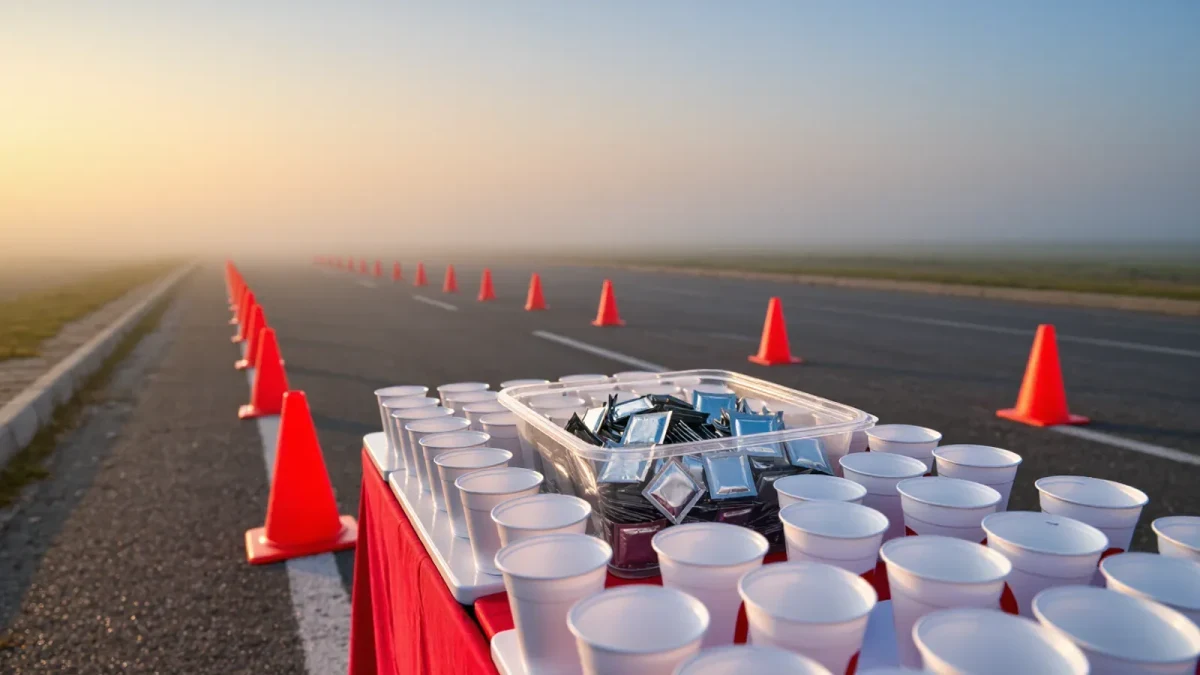
Within the rules, tennis allows intake only at changeovers, roughly every two games, and at set breaks. Match-practice documented in the sports nutrition literature follows that clock: carbohydrate drinks and gels taken in small doses at changeovers, targeting the range international consensus statements support for intermittent exercise lasting beyond 90 minutes — generally described as up to about 60 grams of carbohydrate per hour from single-source products, with higher intakes from mixed glucose-fructose sources studied in endurance contexts and used by some players under team guidance, an attributed practice rather than a recommendation. The sit-down breaks also permit cooling: ice towels and shade are documented in tennis heat-policy literature as effective acute measures, and the sport's extreme-heat rules allow longer breaks when conditions cross thresholds.
Why do players eat bananas?
The courtside banana is a functional choice the literature explains: it is a tolerable, packaged source of roughly 25 to 30 grams of carbohydrate, digestible in the short windows tennis allows, with potassium — an electrolyte the National Institutes of Health identifies as involved in fluid balance and lost in sweat. Studies of fruit as exercise fuel, including controlled trials of bananas in cyclists, show performance effects broadly consistent with sports drinks of similar carbohydrate content. The banana is not magic; it is convenient carbohydrate, and gels or drinks do the same job.
What about caffeine?
Caffeine is one of the best-evidenced ergogenic aids in sport, with meta-analyses showing improvements in endurance, power and skilled tasks at modest doses, including tennis-specific studies showing improved hitting accuracy. Its use in tennis is documented and permitted within anti-doping rules, though timing matters because a five-set match can outlast a dose's peak. Per the IOC consensus on supplements in elite athletes, caffeine is on the short list with strong evidence — and also carries documented individual variability, including tremor and gastrointestinal effects that harm racket skills. This article attributes those findings without dosing guidance.
What does the evidence not support?
No good evidence supports most categories marketed at tennis players: pre-workout stimulant blends beyond their caffeine content, alkaline waters, oxygen supplements or hydration multipliers with trace-mineral claims. The supplement contamination risk documented by anti-doping agencies also applies to players subject to testing, who are advised in IOC and WADA education materials to prefer certified products. For a five-set match, the evidence hierarchy is short: carbohydrate, fluids with sodium for heavy sweaters, cooling, practice at fueling, and conditioning.
How do grand slams manage extreme heat?
Tennis has heat policies of its own, and they are older than football's tournament breaks. The Australian Open, played in the southern summer, operates a documented extreme heat policy built on a heat scale combining factors beyond air temperature, allowing extended set breaks, suspension of play on outer courts and, in the policy's documented forms, a 10-minute break between sets in some matches when thresholds are crossed. Per the International Tennis Federation's framework and published tournament rules, the decision instrument is again wet-bulb globe temperature — the same composite heat-stress index football uses — measured on court, because a hard court in direct sun behaves differently from the same air temperature in shade. Players and teams track these rules when scheduling preparation, per performance-staff accounts.
What happens between matches?
A best-of-five campaign is a feeding schedule as much as a playing one. The tennis recovery literature documents the standard sequence: a recovery meal or snack with carbohydrate and protein soon after leaving the court, then normal high-carbohydrate eating across the 24 to 48 hours before the next match, with sleep prioritized alongside. Grand slam draws can force back-to-back matches after rain, a documented scheduling reality that compresses recovery — one reason teams travel with familiar, tested food rather than improvising in a new city, per team-staff accounts. The IOC consensus on supplements adds the recurring caution for tested players: certified sourcing, because contamination is a documented hazard of the industry.
Do cramps mean low electrolytes?
The honest research answer is: sometimes, and often not only. Exercise-associated muscle cramping has two main documented explanations in the sports-medicine literature — the electrolyte-depletion model, supported by observations of salty sweaters in hot-conditions sport, and the neuromuscular-fatigue model, in which tired nerves misfire into cramp without any shortage of salt. Tennis cramping in long fifth sets fits the fatigue picture at least as well as the sodium one, per reviews that treat the question as unresolved. What the evidence does not support is the courtside folk remedy of pickle juice as salt replacement — though interestingly, studies of cramp-prone athletes found small pickle-juice doses can shorten cramps, with the authors attributing the effect to a mouth-triggered reflex rather than sodium reaching the muscle, a finding worth stating precisely.
Is the serve the first thing to fade?
The match-play data suggest it is among the first. Studies of professional tennis fatigue, which track serve speed and accuracy across long matches, document declining serve velocity and placement in later sets, alongside longer rallies as both players' explosiveness fades. The sports-science interpretation is fuel-linked: serving is a whole-body power effort drawing on glycogen-dependent fibers, and the research on repeated explosive efforts shows those fibers degrade first when carbohydrate runs low. This is the mechanistic reason carbohydrate intake during long matches is not merely about comfort — the measurable skills of the sport ride on the same fuel supply as its running.
Can training prepare the gut for long matches?
Yes — gut training is documented in sports gastroenterology research: practicing match fueling in training improves carbohydrate tolerance and absorption, reducing the stomach discomfort that otherwise caps intake during competition. Tennis adds a skill dimension: players rehearse eating and drinking on the changeover clock so match-day intake is automatic. Reviews of match-play science also note that preparation for heat — acclimatization where the calendar allows — remains the strongest intervention when tournaments are played in summer conditions.
Five-set tennis rewards the player with shots left in the fifth set. The published science says those shots are paid for in advance, in carbohydrate, fluid and practice — changeover by changeover.