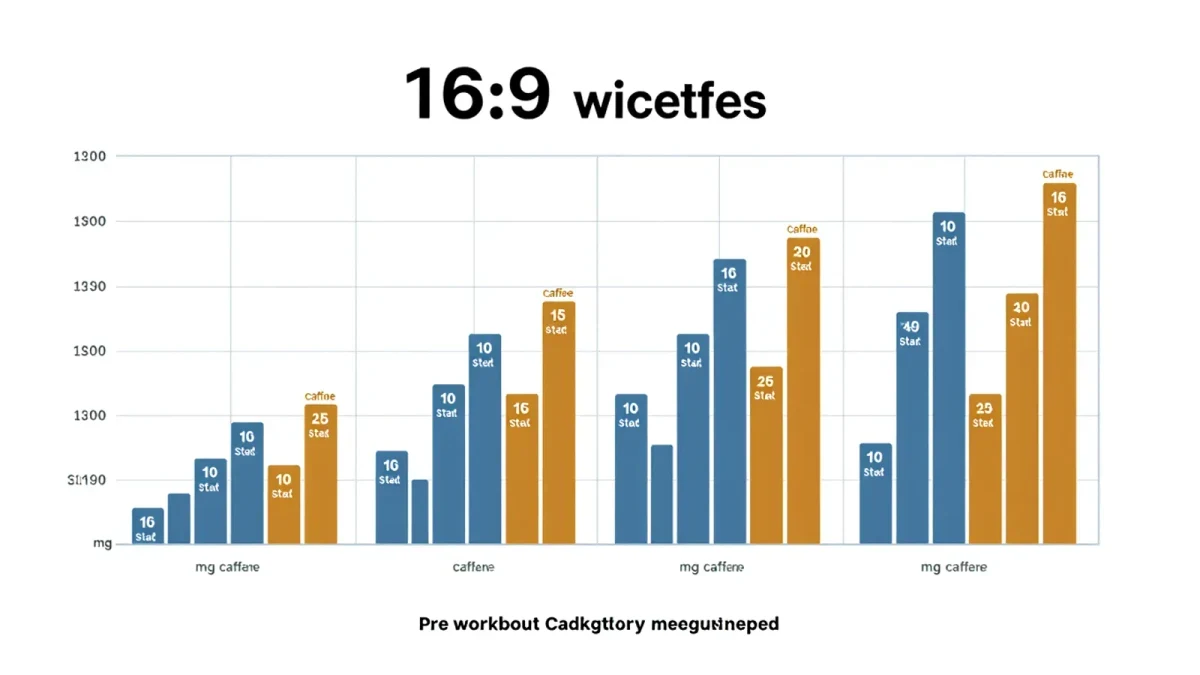
Independent analytical testing of pre-workout supplements has repeatedly found that what is in the container does not match what the label says. The clearest finding concerns caffeine: across studies that chemically assayed pre-workout products, measured caffeine content has diverged from the labeled amount by double-digit percentages in a substantial share of products, and undisclosed stimulants have appeared in some. The pattern is consistent enough that label accuracy, not ingredient choice, is a first-order question for this category.
24 News Click publishes information, not medical advice. Questions about stimulant intake and individual tolerance belong with a qualified clinician.
Why is caffeine the reference case?
Caffeine is the most-studied ingredient in pre-workout products and the easiest to assay, which makes it the natural benchmark for label accuracy. In a widely cited laboratory analysis published in 2005 by Desbrow and colleagues, caffeine content in sampled supplements ranged well outside label declarations in a meaningful proportion of products tested. Later analyses have continued to find mismatches, and the direction varies: some products over-deliver, raising side-effect risk, while others under-deliver, undermining the dose a buyer thought they were getting.
The reason is structural. Under the Dietary Supplement Health and Education Act of 1994, per the National Institutes of Health Office of Dietary Supplements, manufacturers are responsible for their own label accuracy, and the FDA's oversight is largely post-market. There is no government assay of each product before it ships.
What did the DMBA episode show?
The starkest label-accuracy failures involve stimulants that never appear on the label at all. In 2014, Pieter Cohen and colleagues published an analysis in Drug Testing and Analysis identifying DMBA, a stimulant analogous to the banned DMAA, in pre-workout and weight-loss supplements. The ingredient was not declared — it appeared only inside proprietary blends — and it had never been reviewed for safety as a dietary ingredient, per the authors. A follow-up FDA response and subsequent warning-letter actions treated DMBA as an unlawful dietary ingredient, per FDA correspondence from the period.
The DMBA case is the category's cautionary tale: a synthetic stimulant reached retail shelves, listed under blend language, without any human safety data. Label inaccuracy is not always a rounding error on caffeine.
How big are the discrepancies?
Published analyses report a range rather than a single number. Findings across studies of caffeinated supplements generally show three patterns: a majority of products fall reasonably close to label claims; a non-trivial minority deviates by amounts large enough to matter — commonly reported in the range of 20 percent or more, in either direction; and a small number of products contain undeclared compounds entirely. Exact percentages vary by sample and year, and honest coverage states the range rather than a false precision. The consistent conclusion is that deviation is common enough to treat label numbers as estimates.
Do proprietary blends make this worse?
Yes, mechanically. Current US labeling rules require ingredients in a proprietary blend to be listed in descending order by weight — but not the amount of each. Per FDA labeling regulation 21 CFR 101.36, only the total blend weight must be declared. A pre-workout can therefore disclose 300 mg of total stimulant blend without saying how much is caffeine. When independent labs assay such products, the label offers almost nothing to check against. Label-accuracy research consistently finds blends harder to verify than fully disclosed formulas.
What about beta-alanine and citrulline doses?
Non-stimulant ingredients show the same problem with less safety stakes and more efficacy stakes. Beta-alanine and citrulline are typically studied at multi-gram doses; pre-workout blends often contain token amounts too small to match the trial literature. A label-accurate product can still be evidence-inaccurate — the container contains what it says, but the dose is below what studies used. This is a distinct failure of transparency, and it is invisible without either full disclosure or third-party verification.
How can a buyer reduce the risk?
Two practical checks follow directly from the evidence. First, products certified under per-batch programs such as NSF Certified for Sport or Informed Sport have their contents verified against the label for each batch, per both programs' published descriptions — which addresses accuracy, though not whether the doses match the trial literature. Second, fully disclosed labels, with exact milligram amounts per ingredient and no blend language, allow a buyer to compare the formula against published research on each ingredient. Neither check is perfect; together they cover most of what independent testing has found lacking.
Does flavoring and batching explain any of the variance?
Some variance has mundane manufacturing causes. Caffeine is dosed in milligrams into blends weighing hundreds of grams, and mixing equipment distributes powders imperfectly, so two scoops from the same container can differ somewhat. Analytical chemistry adds its own error margin, typically a few percent. Neither factor explains the large deviations reported in the literature — a 20-plus percent mismatch or an undeclared compound is not scoop-to-scoop noise — but both belong in an honest account of why small discrepancies are unremarkable and large ones are not.
What about caffeine from multiple sources?
A related labeling gap involves products that list several stimulant sources — caffeine anhydrous, green tea extract, guarana, yerba mate — without a combined caffeine total. The label can be technically accurate for each line while the buyer cannot compute the actual dose of the one psychoactive ingredient they almost certainly care about. Per FDA labeling guidance for conventional foods and supplements, total caffeine declaration remains inconsistent across the category, and studies that assay such multi-source products often find the effective stimulant load materially different from what a consumer would estimate from the front panel.
Where does the category go from here?
Two developments push accuracy in the right direction. Per-batch certification, discussed above, is spreading from sport products to general retail as consumers learn to recognize the marks. And the FDA's authority over labeling claims — separate from assaying contents — is the mechanism behind most supplement warning letters, per the agency's public enforcement record. Neither force is fast. In the meantime, the evidence-based reading of the category is stable: treat label numbers as approximate, prefer full disclosure, and treat any product whose effects feel dramatically stronger than its labeled dose with suspicion rather than loyalty.
Does price predict accuracy?
The testing record shows no reliable link between price and label accuracy. Premium products have appeared among the mismatched, and inexpensive single-ingredient products have tested clean, because accuracy depends on formulation control and testing discipline rather than positioning. What price does correlate with, weakly, is third-party certification, since certification adds per-batch cost that budget products sometimes skip. The consumer heuristic that follows from the data is to spend attention rather than money: a mid-priced, fully disclosed, batch-certified product outperforms an expensive blend on every dimension the testing literature measures.
FAQ
Are caffeine amounts on pre-workout labels accurate?
Often, but not reliably. Analytical studies have found that a substantial minority of caffeinated supplements deviate from label claims by roughly 20 percent or more, in both directions, per published laboratory analyses. Third-party batch certification is the main consumer check.
Do pre-workouts contain banned substances?
Some have. The 2014 DMBA analysis published in Drug Testing and Analysis found an undeclared synthetic stimulant in pre-workout and weight-loss products. Third-party certification screens per batch reduce, but do not eliminate, this risk.
Is a proprietary blend inherently inaccurate?
A blend is not automatically inaccurate, but it cannot be verified by a consumer. US rules require only the total blend weight, per 21 CFR 101.36, so individual doses stay hidden even when the label is honest.