For delayed-onset muscle soreness — the DOMS that peaks one to two days after unfamiliar or eccentric exercise — three techniques carry the most consistent trial evidence: massage, compression garments and cold water immersion. Stretching, once the default answer, repeatedly fails to reduce soreness in controlled trials, and common painkillers come with trade-offs that limit their use. None of the well-supported methods removes soreness entirely; the honest ceiling is taking an edge off it.
24 News Click publishes information, not medical advice. Severe or prolonged muscle pain, especially with dark urine or swelling, warrants prompt medical attention.
What actually causes DOMS?
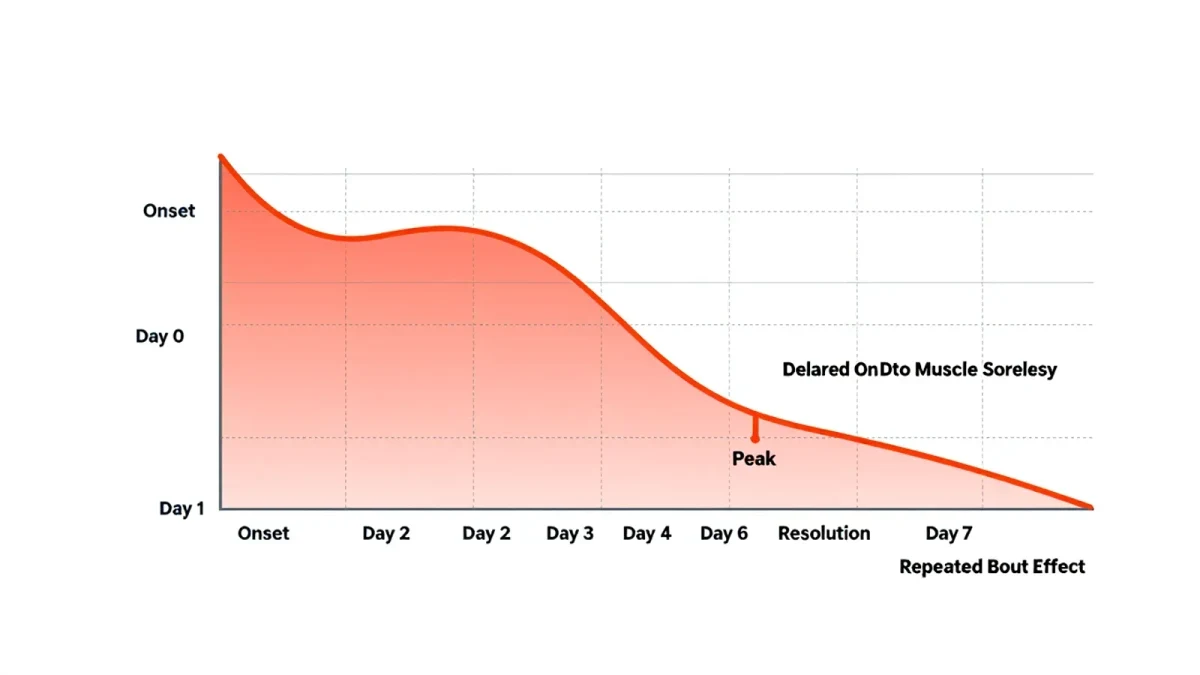
The soreness comes from microscopic damage to muscle fibers, primarily after eccentric contractions — the lowering phase of a movement, downhill running, or any unaccustomed effort. The damage triggers local inflammation and sensitized nerve endings in the muscle, which is why the pain peaks 24 to 72 hours later rather than immediately. Lactic acid, the old explanation, was ruled out decades ago: lactate clears within about an hour of exercise, long before DOMS begins, as reviews including Cheung, Hume and Maxwell's classic 2003 overview in Sports Medicine set out.
Damage sounds alarming, but in ordinary training DOMS is a normal response, and its presence is a poor measure of training quality. Muscle adapts to repeated bouts of the same exercise, producing less soreness over time — the repeated-bout effect, one of the most reliable observations in exercise science.
Which techniques have real evidence?
A 2018 meta-analysis by Olivier Dupuy and colleagues in Frontiers in Physiology compared the major recovery technique families head to head across the pooled trial record. Three came out with the most consistent positive effects on subjective recovery and soreness.
- Massage — the deepest evidence trail, with pooled reductions in perceived soreness; ten to twenty minutes appears in many of the underlying trials.
- Compression garments — small but consistent reductions in soreness and preserved strength, per the 2014 Hill meta-analysis in Sports Medicine.
- Cold water immersion — reliable short-term soreness relief, per a 2016 meta-analysis by Machado and colleagues, with a documented caveat for strength-training blocks discussed below.
The common thread is mechanical or sensory: each technique either assists fluid clearance or dampens soreness signaling. None accelerates tissue repair in any measured way.
What does not work, or barely works?
Stretching is the clearest null result. Trials comparing pre- or post-exercise static stretching against no stretching, pooled in Cochrane reviews on the topic in 2011 and updated in 2023, found effects on subsequent soreness so small as to be clinically meaningless — roughly one point or less on a 100-point scale. Stretching has other uses, but soreness prevention is not among them.
Contrast showers and cryotherapy chambers show inconsistent results across small trials, with reviews repeatedly flagging weak methods. Active recovery — easy movement on sore days — shows mixed evidence: it can temporarily reduce soreness perception while moving, with unclear next-day effects. For painkillers, a careful line is needed: non-steroidal anti-inflammatory drugs such as ibuprofen reduce soreness in trials but also appear in laboratory studies to interfere with some elements of muscle repair and adaptation, and they carry established gastrointestinal and kidney risks with exercise; they are a medical question, not a recovery hack.
What about food and supplements for DOMS?
The supplement shelf is where the evidence thins out most. Protein and carbohydrate support overall recovery and adaptation, but trials have not shown they prevent DOMS when consumed around damaging exercise. Individual ingredients have scattered small trials — omega-3s showed reduced soreness in some small studies of unaccustomed exercise, and tart cherry juice has a modest evidence base around exercise recovery and inflammation — but effect sizes are modest, populations small, and results inconsistent. No supplement has high-quality pooled evidence for preventing or resolving DOMS.
Two things reliably help without any product: time — soreness resolves in three to seven days without intervention — and the repeated-bout effect, meaning the same session hurts far less within weeks.
Should DOMS be trained through?
Usually it can be, at reduced intensity. Research on exercising sore muscles finds performance is often reduced and discomfort higher, but no evidence shows that modest training on sore muscles causes harm or blocks repair. Sensible practice in the literature is lighter work or training unaffected muscle groups, letting the repeated-bout effect do its job. Sharp, localized, or one-sided pain is a different category from diffuse soreness and belongs with a clinician.
| Method | Evidence verdict | Best evidence |
|---|---|---|
| Massage | Modest, consistent benefit | Dupuy et al. meta-analysis, 2018 |
| Compression garments | Small consistent benefit | Hill et al., Sports Medicine, 2014 |
| Cold water immersion | Relieves soreness; may blunt strength gains | Machado et al. 2016; Roberts et al. 2015 |
| Static stretching | No meaningful effect | Cochrane reviews, 2011 and 2023 |
| NSAID painkillers | Reduce soreness; adaptation and medical trade-offs | Laboratory studies on repair signaling |
How is DOMS measured in research?
Every verdict in this article rests on measurement choices worth understanding. Perceived soreness is usually captured on a 100-millimeter visual analog scale — a line on which the participant marks intensity — which is subjective by design and vulnerable to expectation effects. Objective measures include blood creatine kinase, strength loss, and limb swelling, which move with damage but correlate imperfectly with how sore someone feels.
The gap between the two explains some conflicts in the literature: a technique can move soreness ratings while barely shifting blood markers, or the reverse. It also explains why the strongest claims in recovery marketing — where subjective scales dominate vendor-run studies — deserve skepticism. The verdicts above hold up best where subjective and objective measures point the same way.
One caveat on cold water for lifters
Cold water immersion deserves a goal-specific note. A 12-week controlled trial by Roberts and colleagues, published in the Journal of Physiology in 2015, found that trained men who took ten-minute ice baths after lower-body sessions gained less strength and muscle than a group doing easy cycling instead. For soreness management around competition, the pooled data support immersion; during a muscle-building block, the adaptation cost is real.
Does fitness level change any of this?
Largely, it changes the frequency of the problem rather than the remedies. Trained athletes experience DOMS mainly after novel stimuli — a new movement, a dramatic intensity jump, eccentric-biased work like downhill running — because of the repeated-bout effect built through regular training. Beginners meet it early and often, which is why soreness dominates the first weeks of any new program. The evidence verdicts above were gathered mostly in recreationally trained adults and appear stable across fitness levels; what varies is how often the tools are needed.
Practical reading of the evidence
DOMS is a self-limiting, normal process. The methods with real evidence make it somewhat less unpleasant — massage, compression, and cold water each shave a fraction off the soreness curve without accelerating healing. Stretching does not work for this purpose, supplements do not have the evidence their labels imply, and painkillers trade today's comfort against adaptation and medical risk. Unusually severe soreness, especially after extreme exertion in heat, can in rare cases reflect rhabdomyolysis — muscle breakdown needing urgent care — so symptoms out of proportion to the training deserve a clinician, not a recovery gadget.