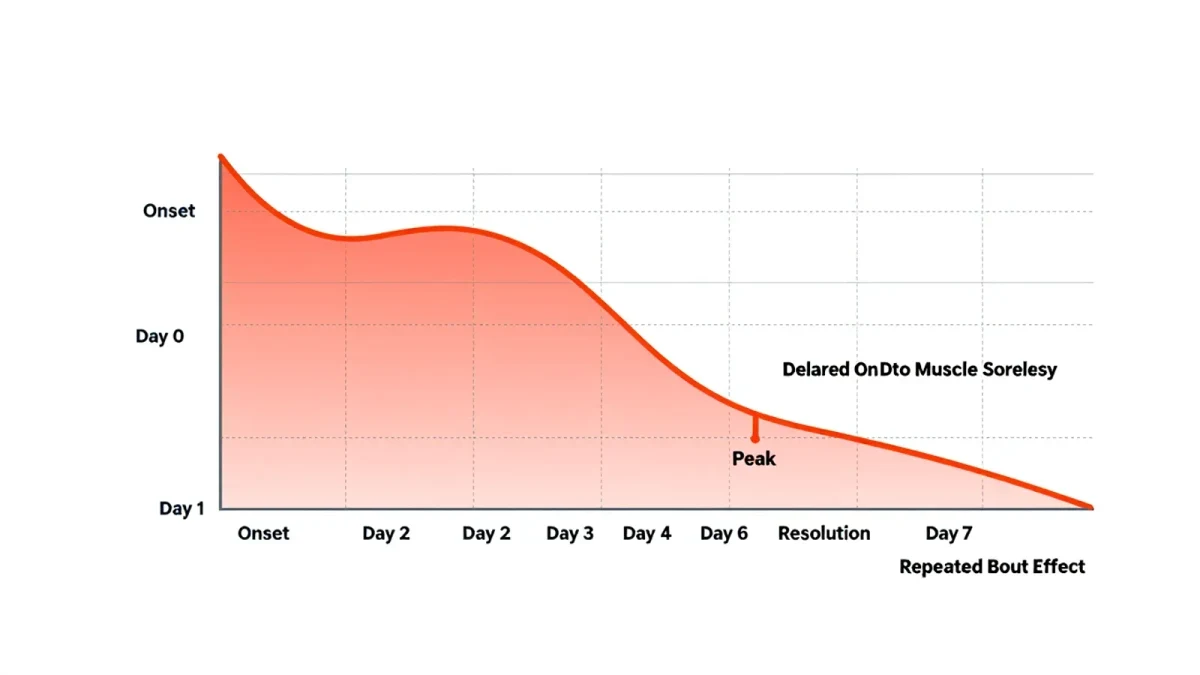
Delayed-onset muscle soreness, or DOMS, is the ache that shows up the day after a hard workout and often peaks a day or two after that. According to Cleveland Clinic, the pain builds over several hours and is usually felt one to three days after exercise, then fades on its own within about a week. That timeline is well documented. What is less settled is how much the soreness itself says about the muscle damage or the recovery underneath it.
The short answer: not much. Soreness and muscle damage are related, but they are not the same measurement, and they do not always move together. A muscle can be sore without being significantly damaged, and it can be recovering well while still feeling tender. Treating soreness as a scorecard for a workout's effectiveness is a common mistake, and it can push people toward training decisions that don't match what is actually happening inside the tissue. We covered a connected angle in Delayed-onset muscle soreness: what works and what does not.
What actually causes the soreness?
DOMS starts with mechanical stress on muscle fibers, most often from eccentric contractions — movements where a muscle lengthens while it is under tension. Lowering a weight, running downhill, or landing from a jump are classic triggers. UVA Health describes this as microscopic breakdown of muscle fibers, which the body then rebuilds, often coming back stronger than before.
The soreness itself isn't the tear. It's the downstream response: swelling, fluid shifts, and sensitized nerve endings in and around the muscle. Cleveland Clinic lists tenderness to touch, stiffness, reduced range of motion, and temporary weakness as the common package. None of these symptoms is a direct readout of how many fibers were affected or how serious the disruption was. They are a rough surface signal layered on top of a much more variable internal process.
This is why two people can do the identical workout and end up with very different soreness the next day. Genetics, training history, sleep, and even how attentive someone is to body sensations all shape how soreness is perceived, separate from what happened at the tissue level.
Does soreness measure how well the workout worked?
No — soreness is a poor proxy for training effectiveness, and this is one of the more persistent myths in the gym. A workout can build strength or endurance with little to no next-day soreness, and a workout can produce brutal soreness while contributing very little to fitness beyond the discomfort itself.
Choose PT, a patient-education resource from the American Physical Therapy Association, frames normal post-exercise soreness as a sign that healthy stress was applied to muscles, bones, and connective tissue, not as a target to chase. The resource notes that how sore someone gets depends on the intensity and novelty of the activity, not on some fixed dose of "productive" damage.
Chasing soreness as proof of a good session tends to backfire. It encourages ever-harder eccentric loading in search of a feeling rather than progress on a measurable variable like load lifted, distance covered, or how a movement feels over weeks. Soreness is a side effect of novelty and intensity, not a report card.
The recovery question that matters more than "was I sore enough" is whether performance and range of motion are returning to baseline before the next hard session.
How is soreness different from an injury?
This distinction matters because it changes what a person should do next. Choose PT lays out several markers that separate ordinary soreness from a developing injury. Soreness affects the general area of muscles that were worked, builds gradually, and eases with light movement. Injury pain tends to sit in one specific spot — a joint or tendon — can be sharp during a particular movement, may keep someone awake at night, and doesn't reliably improve with rest.
Cleveland Clinic adds a simple duration rule: DOMS should resolve within a few days. Pain that lingers past about a week, or that gets worse instead of better, points toward a strain or another injury rather than ordinary soreness.
There is also a rare but serious condition worth knowing about. UVA Health describes rhabdomyolysis, a breakdown of muscle tissue serious enough to affect kidney function. Physician David Hryvniak, DO, is quoted describing it as soreness "way out of proportion to the level of effort" that isn't improving, sometimes paired with dark, tea-colored urine. UVA Health calls this a medical emergency requiring same-day evaluation. It typically follows extreme, sudden exertion rather than a normal, gradually progressed workout, and dehydration and exercising in heat raise the risk. This is a distinct condition from ordinary DOMS, not a more severe version of it, and it is not something to self-diagnose.
Why does soreness duration vary so much between people?
Two lifters doing the same leg session can end up a full day apart in when their soreness peaks and clears. Training history is the biggest factor: a muscle group that has adapted to a movement pattern produces far less soreness the second or third time it's loaded that way, even at a similar intensity. This is sometimes called the repeated-bout effect, and it's a large part of why the first week of a new program is almost always the sorest.
The type of contraction matters too. Eccentric-heavy movements — lowering phases, downhill running, deep lunges — reliably produce more soreness than concentric-dominant work, according to both Cleveland Clinic and UVA Health. Someone doing a lot of eccentric work for the first time should expect more soreness than someone doing familiar, balanced training, independent of how "hard" either session felt in the moment.
Individual variation in pain sensitivity, sleep quality, hydration, and even psychological stress also plays a role in how soreness is reported, separate from the physical process happening in the muscle. This is one reason self-reported soreness scales are a weak tool for comparing training effectiveness across different people, even inside the same research study.
What this means for training decisions
Practical implication: soreness is a signal to interpret, not a target to hit and not proof that a session failed. Mild, generalized soreness that eases with light movement and clears within a few days is a normal and expected companion to progressive training, as Choose PT frames it. It doesn't need to be eliminated, and it doesn't need to be maximized either.
What deserves attention instead is anything outside that normal pattern: pain concentrated in one joint or tendon, soreness that keeps worsening rather than improving, or soreness paired with dark urine or soreness clearly out of proportion to the workout performed. Those are reasons to involve a clinician, not to push through with a foam roller and hope.
For everyday training, the more useful markers are the ones soreness doesn't capture well: whether strength and range of motion have returned to baseline, whether sleep and daily function feel normal, and whether the next session can be performed with reasonably normal form. Readers weighing specific recovery tools against this backdrop can look at the evidence on what works and what does not for delayed-onset muscle soreness, or compare structured approaches in the piece on active recovery or complete rest. This article is intended as general information, not a substitute for individualized medical or clinical advice; anyone with pain that doesn't fit the normal DOMS pattern should see a qualified clinician. For related coverage, see Active recovery or complete rest: which works better?.