Percussion massage guns — handheld devices that deliver rapid pulses into muscle tissue — have modest short-term support in the research record: small trials show brief improvements in range of motion and reductions in perceived soreness after exercise, roughly in line with what traditional massage delivers. The evidence base as of early 2026 consists of small, short studies, and no long-term trial has tested whether the devices improve actual recovery outcomes or performance over a season.
Decisions about treating pain or injury belong with a qualified clinician, and a massage gun is not a substitute for one.
What is a massage gun actually doing?
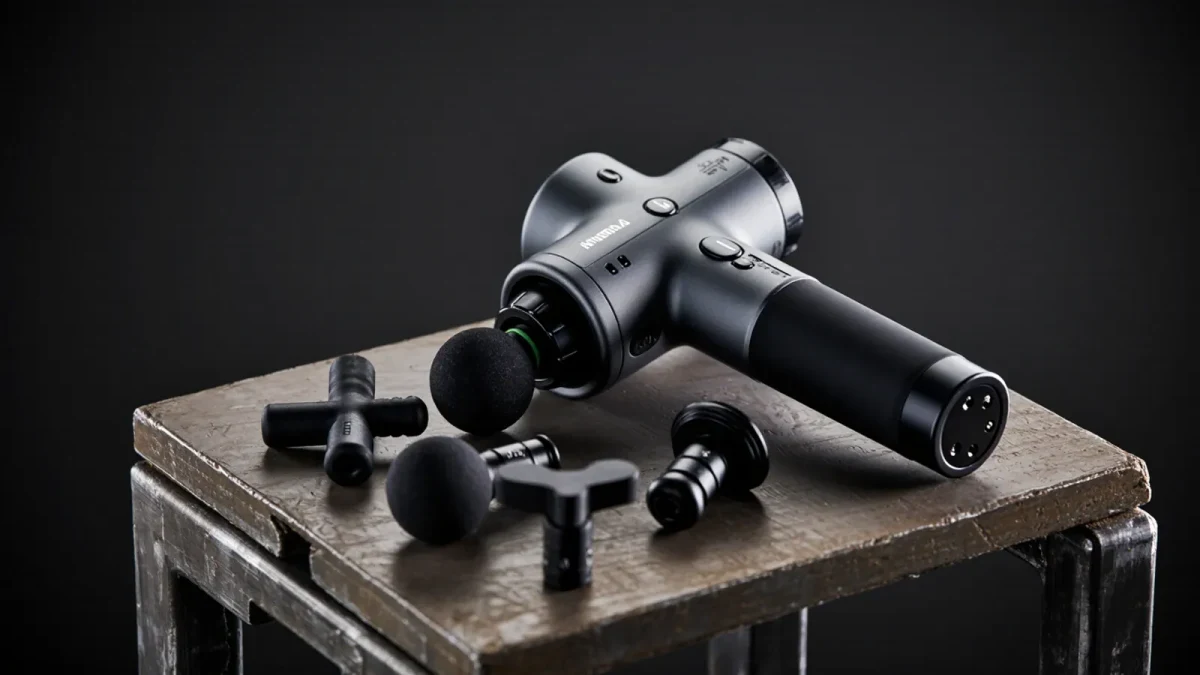
These devices, sometimes called percussive massagers, apply rapid-amplitude pulses — commonly around twenty to fifty strikes per second, depending on the model and speed setting — through a rubber or foam attachment. The stated intent is the same as manual massage: deliver mechanical stimulation to skin, fascia and muscle, locally increase blood flow, and modulate the sensation of tightness through the nervous system.
The devices became a mass-market category in the late 2010s and are sold by dozens of brands. No massage gun has been evaluated by a medicines regulator for any therapeutic claim; in most markets they are general wellness devices. Manufacturer marketing claims about breaking up scar tissue or accelerating healing are the manufacturers' claims, not findings.
Do massage guns improve flexibility?
Short-term, probably yes — slightly. Several small controlled trials, including work by Konrad and colleagues published in 2020 in the International Journal of Environmental Research and Public Health, found that brief percussion treatment on the calf or hamstring increased joint range of motion immediately afterward, by amounts in the range of a few degrees, comparable to the effect sizes seen with a short bout of static stretching in the same studies.
The mechanism proposed is not structural lengthening of tissue in a thirty-second treatment. Researchers attribute the immediate effect to altered stretch perception — the nervous system tolerates more range before signaling discomfort. The trials measure range of motion minutes after treatment; they do not show lasting flexibility change over weeks.
Do they reduce muscle soreness after exercise?
The soreness evidence is thin but directionally positive. A small number of trials have compared percussion treatment after damaging exercise against no treatment or manual massage, generally reporting lower perceived soreness scores in the following one to three days. Reviews of the percussion-therapy literature published around 2021 in sports-science journals concluded that the available data were promising for acute soreness and flexibility but of low quality — few participants, no blinding of a vibrating device, heterogeneous protocols.
Notably, in trials that included a manual-massage comparison group, percussion devices generally performed about the same as a therapist's hands for short-term outcomes. That is a useful framing: the devices seem to deliver a massage-like effect, not a new one.
Can a massage gun improve performance directly?
Probably not meaningfully. Trials that measured jump height, sprint speed or strength immediately after percussion treatment mostly find no significant improvement, and at least one small study reported slightly reduced force output after aggressive treatment on the tested muscle — consistent with research on static stretching and pre-activity force. Using the device in a warm-up for an acutely power-based task is therefore not supported by current data; using it on non-tested areas, or after activity, is where the evidence points.
- Flexibility: small immediate gains, comparable to brief static stretching (Konrad et al., 2020).
- Soreness: lower perceived soreness in the days after exercise in small trials, similar to manual massage.
- Power and strength: no reliable improvement; possible small acute force reduction after aggressive treatment.
Are there risks?
Industry and clinical guidance converges on a short list of cautions. Percussion devices should not be used on bony areas, the front or side of the neck, the groin, or over known blood clots, open wounds, fractures, or acute injuries. People on anticoagulant medication or with vascular disease face bruising and, theoretically, clot-related risks from vigorous vibration over vessels. These are standard cautions of the device category, and persistent pain that prompts daily gun use is a symptom worth raising with a clinician rather than masking.
How do trials test a vibrating device fairly?
Method quality deserves a note, because it explains the caution in this field. A massage gun cannot be hidden from the person using it: participants always know whether they received treatment, which opens the door to expectation effects in subjective outcomes like soreness ratings — precisely the outcomes most often reported. Trials partially handle this by including placebo-style comparisons, such as a switched-off or low-amplitude device, but only a handful have done so.
Duration is another limit. Most published protocols treat a single muscle for thirty seconds to a few minutes and test outcomes within minutes or across one to three days. Whether the devices repay daily use over a season — the way most owners actually use them — has simply not been studied. The evidence, such as it is, covers acute sessions in small groups, and the reviews that summarize it consistently end on the same word: preliminary.
How does the evidence compare with massage and foam rolling?
Manual massage has the deepest evidence trail of the mechanical-recovery family: a 2018 meta-analysis by Dupuy and colleagues in Frontiers in Physiology rated massage among the most consistently supported techniques for post-exercise subjective recovery. Foam rolling sits in between, with a moderate pool of trials showing small short-term flexibility and soreness benefits. Percussion guns, with their far younger research base, currently sit alongside foam rolling as plausible but thinly tested — the device category is roughly a decade old in its research life.
| Method | Evidence depth | Main supported effect |
|---|---|---|
| Manual massage | Deep, pooled in meta-analyses | Soreness and perceived recovery |
| Foam rolling | Moderate | Short-term flexibility, soreness |
| Percussion gun | Shallow, small trials | Immediate flexibility, soreness; similar to massage |
How should the short-term findings be read in practice?
Translating small acute studies into everyday training requires restraint. A few degrees of ankle range measured minutes after treatment is a laboratory endpoint; whether that difference changes a training session has not been tested. Similarly, soreness scores one or two points lower on a ten-point scale are real in statistics and may still leave the user clearly sore. The devices are best understood as comfort tools with massage-level evidence — useful to people who enjoy them, unproven as anything more.
Is an expensive model worth it?
No published trial has compared massage-gun brands or price tiers against each other on outcomes. Studies generally use one device at one protocol and compare against control or massage. Claims that a given motor, amplitude or attachment system is clinically superior are marketing, not evidence. A device that is comfortable to use consistently covers what the research supports.
Bottom line
The honest reading: massage guns appear to deliver a small, transient increase in range of motion and some soreness relief, roughly on par with the manual techniques they imitate. Nothing in the current record shows superior recovery, injury prevention, or performance gains, and the whole evidence base is small. For people who find the devices pleasant and use them after training, the data raise no alarm; for anyone buying one expecting more than massage-level effects, the studies do not support that expectation.