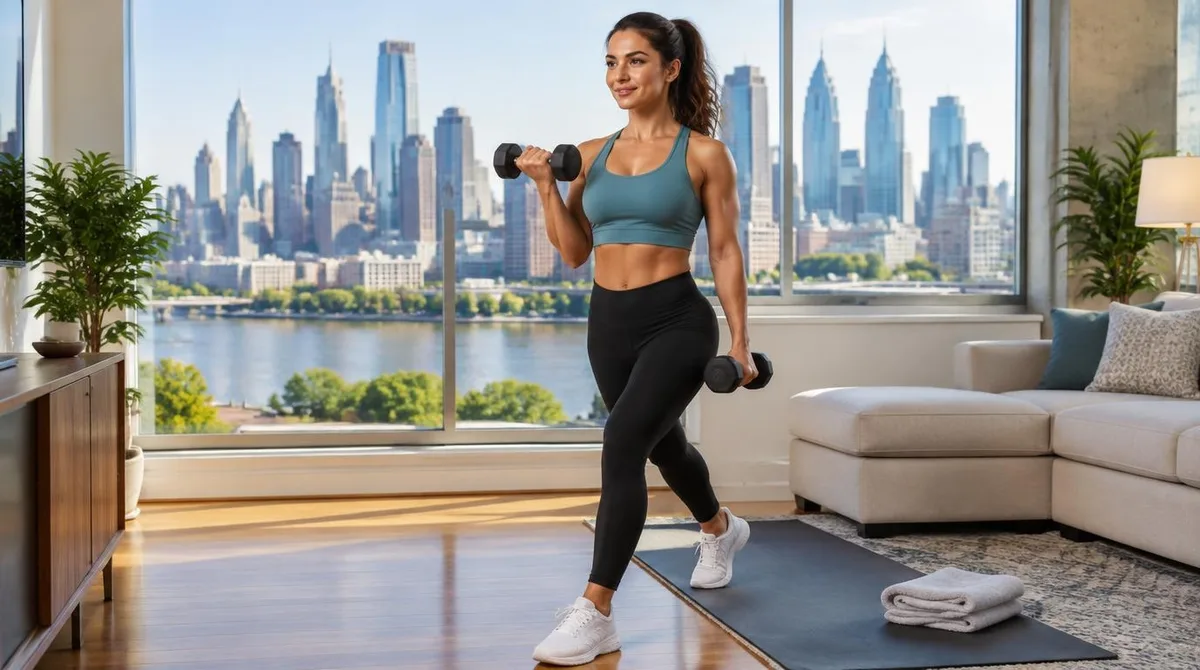
Philadelphia's WPVI-TV published a fitness tip on November 26, 2026, in which presenter Shoshana demonstrates a flat bicep curl with a step back, using light hand weights. The segment describes it as a simple exercise that works the entire body. That last claim is the interesting part, because it is doing a lot of work in very few words.
The tip itself is unremarkable and useful in the way most short form fitness tips are: one movement, minimal equipment, something a viewer can try at home. The framing around it is what deserves scrutiny. "Works your entire body" is a standard broadcast shorthand for a compound movement, and fitness media uses it loosely. It does not mean the exercise trains every muscle equally, or that it can replace a full program. It means the movement involves more than one joint and more than one muscle group.
What the segment actually says
The published text is brief. Shoshana "shows us a simple exercise using some light hand weights that works your entire body," according to 6abc, credited to the station's digital staff. The article is a companion to a video, which is where the instruction lives. The written piece does not detail technique, sets, reps, or progression. It points viewers to the station's archive of previous tips at 6abc.com/TodaysTip.
That structure matters for interpretation. A written summary of a video demo cannot carry coaching cues, so the reader gets the claim without the mechanics. Anyone trying the movement from text alone is guessing at the part that determines whether it helps or annoys a shoulder.
Why the "step back" variation exists
The name of the movement suggests the point. A plain bicep curl is an isolation exercise: it moves one joint, the elbow, and targets the upper arm. Adding a step back turns it into something with a lower-body component and a demand on balance and coordination. That is a common pattern in short-form fitness content, and a sensible one. It raises the movement's cost in effort without raising the load, which suits the "light hand weights" constraint the segment names.
The trade-off is precision. When a curl becomes a full-body pattern, the arm work gets diluted unless the movement is controlled. This is the same tension discussed in coverage of tempo training: slowing a lift down changes what the set demands, and rushing it changes what it delivers. A step-back curl done fast is cardio with a dumbbell in hand. Done slowly, it is a curl plus a controlled step, which is closer to what the segment appears to intend.
The honest reading of "entire body"
Here is the analytical judgement, and it is the publication's own: the claim is directionally fair but easy to overread. A compound movement with a step does recruit more musculature than a seated curl. It does not follow that one exercise, done occasionally with light weights, constitutes training for the whole body. Research on training structure consistently points to total weekly work per muscle as the variable that matters, a question examined in detail in coverage of how many weekly sets per muscle group the research supports. A single tip-format movement is an entry point, not a program. For related coverage, see How many weekly sets per muscle group does research support?.
That is not a criticism of the segment. Broadcast fitness tips serve a different job than programming advice. Their real value is lowering the barrier to starting. A viewer with no gym, no barbell, and ten spare minutes can attempt this movement today. The gap between "this is a reasonable thing to try" and "this replaces structured training" is where most fitness content quietly misleads, and this segment sits on the correct side of it as long as the viewer reads the claim with that gap in mind.
Where a tip like this fits in a real week
The useful context is progression. Light hand weights limit how far a movement can take a person, which is why the concept of how progressive overload actually works is the natural next question. If the weights never get heavier and the movement never gets harder, adaptation stalls. A tip-format exercise is a starting point that needs a plan behind it, something laid out plainly in coverage of strength training for beginners.
It is also worth noting what the segment does not claim. It makes no promise of transformation, no weight-loss pledge, no "one weird trick" framing. Compared with the marketing language that surrounds supplements and home-fitness products, a station demoing a movement with light dumbbells is a fairly honest genre. The overreach, such as it is, lives in the word "entire," and readers can discount it accordingly.
What to watch next
The segment is one entry in an ongoing daily series, with previous tips covering standing crunches, pulley rows, a Pilates-inspired oblique exercise, and alternating shoulder presses, per WPVI. Read together, the series is a library of single movements rather than a curriculum. The practical takeaway for readers: try the movement if it appeals, but treat it as one brick. Consistency beats optimization, and a daily tip is only as good as the habit it helps build.